The Silent Army that keeps Big Tech in Check
AI Quick Summary
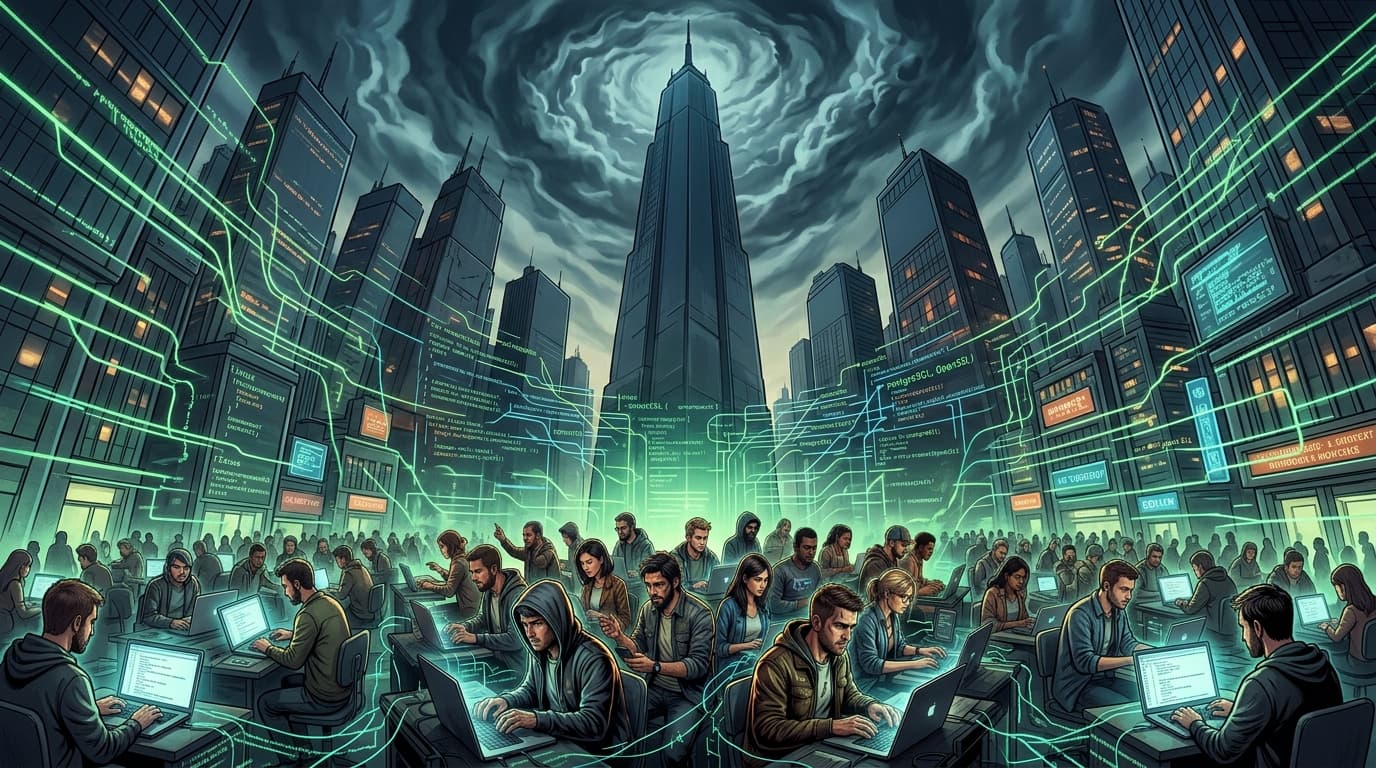
When people imagine a check on the power of giant tech companies, they picture regulators, antitrust lawsuits, or rival corporations. Few picture a loosely organized, often unpaid, global community of programmers. Yet that community has, for decades, quietly kept the entire industry from being owned outright by a handful of companies.
The PostgreSQL Story
Few examples make the point as clearly as PostgreSQL, one of the world's most trusted databases, running underneath everything from fintech apps to government systems. Its roots trace back to 1986, when Professor Michael Stonebraker led the POSTGRES project at the University of California, Berkeley, funded by research grants rather than corporate backing.

When the university project wound down, a pair of graduate students added SQL support and released it to the web as Postgres95. From there, control passed not to a company, but to an open, international group of developers who renamed it PostgreSQL and have maintained it as a community project ever since with no owner.
Decades later, PostgreSQL competes directly with database products from Oracle, Microsoft, and Amazon, companies with virtually unlimited resources, and in many technical benchmarks, it wins and is used by these companies. No single company owns it. No single company can discontinue it, paywall it, or quietly degrade it to protect a competing product line.
MySQL: A Cautionary Companion Story
MySQL tells a more complicated version of the same story. Originally built by a Swedish company, it became wildly popular as free, open-source software, before being acquired by Sun Microsystems, and then by Oracle in 2010. The acquisition alarmed much of the open-source community, since Oracle now owned both a dominant commercial database and its most popular free rival.
The response was fearing that Oracle might neglect or restrict MySQL to protect its paid products, key original developers forked the codebase and created MariaDB, a fully open alternative that continues to be maintained independently today. The threat of community exodus, and the existence of a ready-made fork, has functioned as a kind of insurance policy, a built-in check that no single company fully controls the technology, no matter who holds the trademark.
Linux: The Operating System No One Owns
Linux is perhaps the starkest example of what community-driven software can become. Started by a Finnish student, Linus Torvalds, as a personal project in 1991, it now runs the majority of the world's servers, nearly all public cloud infrastructure, and the Android operating system on billions of phones. Companies including Google, IBM, Intel, and Microsoft now employ engineers specifically to contribute to the Linux kernel, but no one of them controls its direction.

Decisions are made through a maintainer system built on technical merit and community consensus, not corporate ownership. A world where the operating system underneath most of the internet was instead owned by a single company is not hard to imagine, it is simply the world we don't live in, because Linux exists.
What Happens When the Community Is Ignored
The flip side of this story is a warning. In 2014, a bug called Heartbleed was discovered in OpenSSL, the open-source software responsible for encrypting roughly two-thirds of the internet's websites, including services run by many of the world's most profitable companies. When the bug became public, it emerged that OpenSSL was maintained by a tiny team of largely unpaid volunteers, with the project receiving donations averaging roughly $2,000 a year despite securing much of global online commerce and banking.
Companies worth hundreds of billions of dollars were running their entire security infrastructure on code maintained by four part-time volunteers. It took Heartbleed, a genuine global security crisis, for major tech companies to start funding the open-source projects they had quietly depended on for free for years.
What If Corporations Had Full Control?
It's worth sitting with the counterfactual. If every foundational layer of technology, operating systems, databases, encryption libraries, web servers, programming languages, were owned outright by a small number of companies, the implications would be significant. Pricing could rise without any competitive alternative. Companies could discontinue products that no longer served their bottom line, regardless of how many people depended on them.

Governments and smaller companies alike would have no real negotiating leverage, since switching away from proprietary infrastructure would mean rebuilding from scratch. Security scrutiny would depend entirely on each company's internal priorities, with no independent community of outside developers routinely reading, testing, and challenging the code.
Open source doesn't eliminate corporate power in tech, companies like Google, Microsoft, Amazon, and Meta remain enormously influential, and many of them now contribute to, and in some cases steer, major open-source projects themselves. But the existence of community-owned, forkable, independently governed alternatives means no single company can fully dictate the terms on which the digital world runs. If a company abandons a project, neglects it, or tries to lock users in, the community can fork it and continue, exactly as happened with MySQL and MariaDB.
The Invisible Army Most People Never Think About
What makes this system remarkable is how invisible it is to the average person. Billions of people use software built on Linux, PostgreSQL, OpenSSL, and thousands of other open-source projects every single day, through their banking apps, their phones, their workplaces, without ever knowing these tools exist, let alone that they're maintained by volunteers, part-time contributors, and small nonprofit foundations operating on shoestring budgets.
Consider this: The code securing your online banking session, the database storing your hospital records, and the operating system running your home router may all trace back to people who received no payment, no public recognition, and in many cases, barely enough donations to cover a laptop.
This is the quiet, often thankless layer of modern technology, a decentralized, globally distributed community that no boardroom fully controls and no single company can simply acquire away. It isn't flashy, it rarely makes headlines unless something breaks, and most of the people using its output will never know its contributors' names. But it remains one of the few forces genuinely capable of keeping the balance of power in technology from tipping entirely into the hands of a few corporations, one commit, one pull request, and one volunteer maintainer at a time. What is fascinating, is that anyone can be a contributor to open source projects.
If you enjoyed this article, follow us on WhatsApp for daily tech updates. If you have an idea, need to be featured or need to partner, reach out to us at editorial@techinika.com or use our contact page.
Don't let the story end here.
Share your thoughts, ask questions, and connect with the community.

Cishahayo Songa Achille
Chief EditorCishahayo Songa Achille is a prominent Rwandan software engineer, tech entrepreneur, and digital content creator.
View all articles by Cishahayo Songa Achille →Up Next
Could Rwanda Become Part of Africa’s Emerging Chip Industry?By ISHIMWE Jean Claude • 3 min read