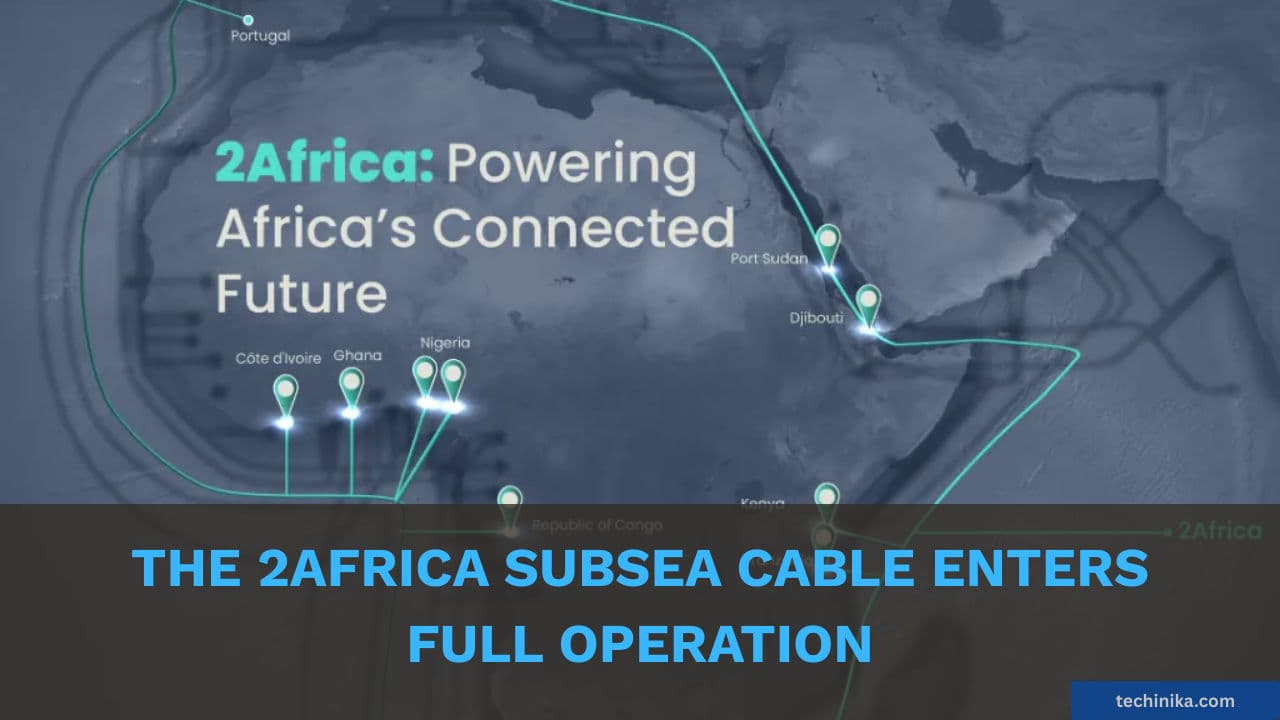
The 2Africa Subsea Cable Enters Full Operation
AI Quick Summary
- The 2Africa subsea cable's core system was completed in late 2025, becoming the world's longest open-access submarine cable network.
- It spans approximately 45,000 kilometers, connecting 33 countries across Africa, Europe, and Asia, and is designed for a total capacity of 180 Tbps.
- The system utilizes Spatial Division Multiplexing (SDM) with up to 16 fiber pairs for enhanced data transmission and reliability.
- Operating under an open-access model, it enables local providers to lease capacity fairly, fostering digital inclusion for over 3 billion people.
- Strategic landing points and branch expansions, like Airtel Nigeria's second gateway, are improving network resilience and positioning connected regions as major connectivity hubs.
The core 2Africa cable system was completed and activated in late 2025, and its "Pearls" extension to India and Pakistan is expected to go live in 2026, further expanding its global reach.
In late 2025, the core system of the 2Africa subsea cable was completed, marking a major milestone in global digital infrastructure. Spanning approximately 45,000 kilometers and connecting 33 countries across Africa, Europe, and Asia, the system has become the world’s longest open-access submarine cable network. Its activation represents a structural shift in how international data flows to and from African markets.
Foundational Infrastructure
The 2Africa project is a 45,000-km subsea fiber-optic network encircling the continent to link 33 countries across Africa, Europe, and Asia. Launched in 2022 by a consortium including Meta, Bayobab, Vodafone, Orange, China Mobile, Telecom Egypt, center3, and WIOCC, the system reached core completion in late 2025. With the final integration of the Pearls extension in 2026, the network will deliver a total design capacity of 180 Tbps.
The infrastructure features strategic landing points in key markets; such as Nigeria, South Africa, Kenya, and Egypt; operating under an open-access model. These neutral gateways allow local providers to lease capacity fairly, extending high-speed connectivity from the coast to landlocked nations via terrestrial networks. Ultimately, this massive digital loop aims to foster digital inclusion for over 3 billion people.
Technical Architecture and System Capabilities
The system is built using advanced subsea fiber technology designed for scale, flexibility, and long-term reliability.
- Spatial Division Multiplexing (SDM): Enhances data transmission by increasing the number of fiber pairs within the cable system.
- Up to 16 Fiber Pairs: Supporting a design capacity of up to 180 Terabits per second (Tbps).
- High-Capacity Optical Transmission Systems: Enabling large-scale traffic handling for cloud platforms, enterprise networks, and consumer services.
- Redundant Routing and Power Architecture: Improving resilience and reducing the risk of large-scale service disruptions.
- Open-Access Infrastructure Model: Allowing multiple telecom operators and service providers to lease capacity and expand network reach.
This technical architecture positions the cable to meet rising demand driven by streaming platforms, enterprise cloud adoption, fintech expansion, AI workloads, and broader digital transformation across connected markets.
Strategic Moves and Market Shifts
Since construction began in 2022, the 2Africa project has influenced telecom strategies and infrastructure investment across multiple regions.
- Airtel Nigeria’s activation of a second international internet gateway via 2Africa through Kwa Ibo in Akwa Ibom State. This critical move reduces reliance on Lagos as the primary entry point, significantly improving national traffic distribution and overall network resilience.
- Early landings in South Africa, including at Yzerfontein and Duynefontein, strengthened Southern Africa’s role in global data routing and expanding redundancy in the region.
- Progressive landings in West Africa, including Nigeria and Ghana, increasing international bandwidth capacity and reinforcing their positions as regional connectivity hubs.
- Consortium-announced branch expansions to additional markets such as Angola, the Seychelles, and the Comoros Islands, extending the system’s footprint beyond its initial core route.
With its core infrastructure now operational, 2Africa transitions from a long-term construction project into a functioning backbone of global connectivity. Its scale, open-access ownership structure, and technical capacity position it as a central element in evolving international data flows.
As integration continues across coastal and inland networks, the system is expected to strengthen resilience, expand competition, and support sustained digital growth across the regions it connects.
If you enjoyed this article, follow us on WhatsApp for daily tech updates. If you have an idea, need to be featured or need to partner, reach out to us at editorial@techinika.com or use our contact page.
Don't let the story end here.
Share your thoughts, ask questions, and connect with the community.

Kellycie Bayingana
AuthorPassionate about the intersection of technology and storytelling. I am committed to uncovering and sharing the most compelling startup narratives from across Rwanda for Techinika.
View all articles by Kellycie Bayingana →