The Evolution of PPE: How Smart Helmets are Transforming Construction Safety
AI Quick Summary
- Traditional hard hats are evolving from passive protection to sophisticated smart helmets, integrating hardware and software for active monitoring.
- These smart helmets act as IoT devices, providing real-time communication and data analysis on construction sites.
- They feature sensors for impact and fall detection, physiological monitoring (heart rate, body temperature), and environmental hazard sensing (e.g., carbon monoxide).
- Smart helmets also offer proximity and geofencing alerts, warning workers about heavy machinery or restricted zones.
- Advanced models can integrate Augmented Reality (AR) to project Building Information Modeling (BIM) data, improving efficiency and reducing errors.
For over a century, the hard hat has remained a static piece of equipment; a reliable but passive barrier designed to mitigate the impact of falling debris. However, as modern construction sites grow in complexity, physical protection alone is no longer sufficient. We are witnessing a fundamental transition where the traditional helmet is being redesigned into a sophisticated data hub, integrating hardware and software to actively monitor site conditions and physiological health in real-time.
The Evolution: From Canvas to Connectivity
The journey of head protection began in 1919 with the "Hard-Boiled Hat," a simple mix of steamed canvas and glue. For decades, innovation was limited to materials, moving from aluminum in the 1930s to the fiberglass and plastic shells used today. The real breakthrough, however, isn't in the shell itself, but in the electronics now being embedded within it.
This shift has effectively transformed a century-old piece of plastic into an Internet of Things (IoT) device capable of real-time communication and data analysis.
How It Detects: The Engineering Behind the Intelligence
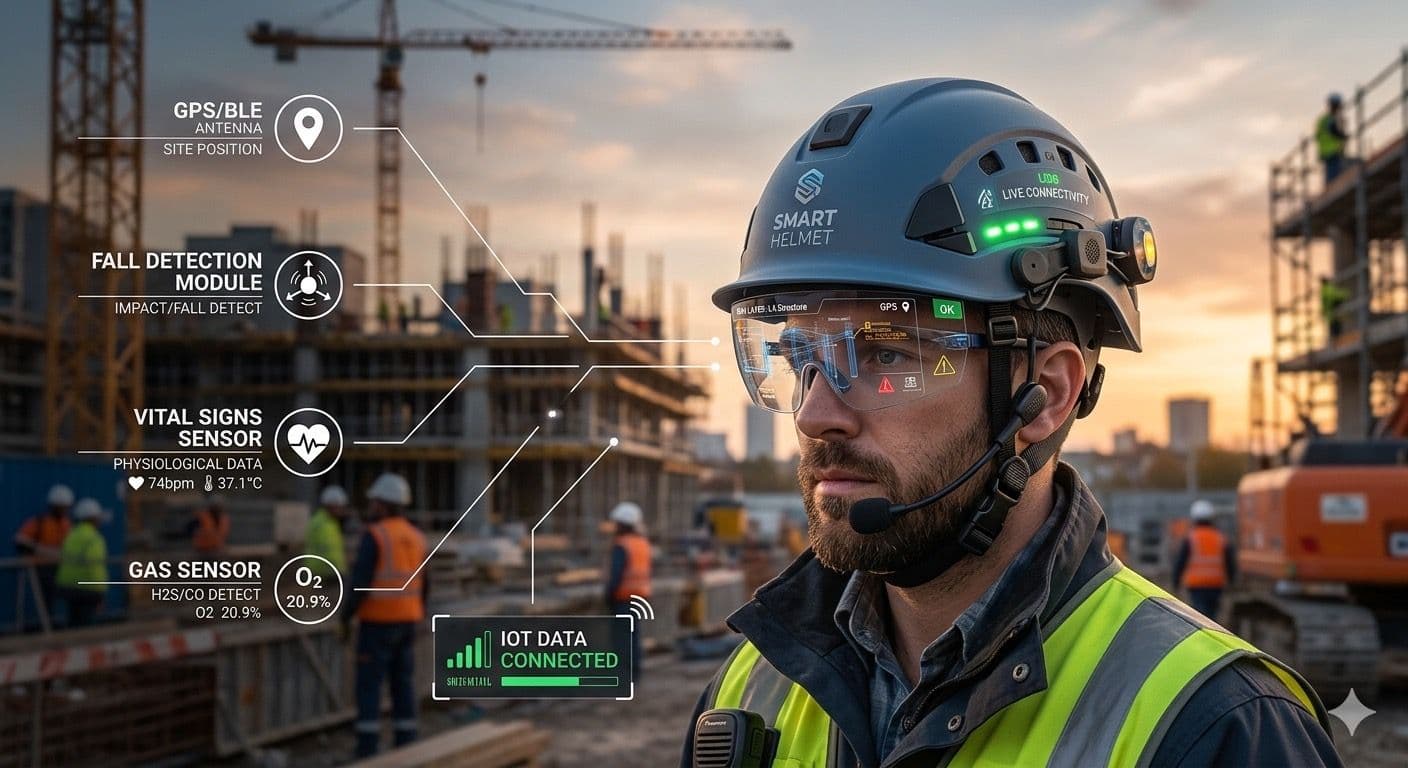
A smart helmet functions as a ruggedized, wearable computer that maintains a constant link to a central site management dashboard. It utilizes a precision array of sensors to provide a 360-degree view of both worker safety and environmental hazards.
Impact and Fall Detection: Integrated 6-axis gyroscopes and accelerometers allow the system to differentiate between routine physical labor and a hazardous fall. In the event of an incident, the helmet automatically broadcasts an SOS alert with precise GPS coordinates to emergency responders.
Physiological Monitoring: Embedded sensors track vital signs such as heart rate and core body temperature. This allows the system to identify early markers of heatstroke or physical exhaustion; critical factors in preventing accidents on high-exposure projects.
Environmental Hazard Sensing: The equipment can detect invisible threats common on construction sites, such as carbon monoxide, methane, or oxygen-deficient atmospheres, providing immediate haptic or auditory warnings to the wearer.
Proximity and Geofencing: Using Ultra-Wideband (UWB) or Bluetooth Low Energy (BLE) technology, the helmet alerts workers when they approach heavy machinery or enter restricted red zones on the job site.
Augmented Reality (AR) Integration: Advanced models feature transparent visors that project Building Information Modeling (BIM) data. This enables engineers to visualize structural, mechanical, and electrical systems in situ before installation begins, reducing error and improving efficiency.
The transition to smart helmets represents a strategic shift toward a data-driven safety culture. By converting a century-old piece of protective gear into an intelligent monitoring system, the construction industry is establishing a new standard for risk management. As these technologies become standard on the job site, we move closer to a future where the health and safety of the workforce are as meticulously engineered as the structures they build.
If you enjoyed this article, follow us on WhatsApp for daily tech updates. If you have an idea, need to be featured or need to partner, reach out to us at editorial@techinika.com or use our contact page.
Don't let the story end here.
Share your thoughts, ask questions, and connect with the community.

Kellycie Bayingana
AuthorPassionate about the intersection of technology and storytelling. I am committed to uncovering and sharing the most compelling startup narratives from across Rwanda for Techinika.
View all articles by Kellycie Bayingana →