Why Solar is Overtaking Fintech in Africa's Investments!
AI Quick Summary
- By January 2026, Renewables and Cleantech, especially solar, have emerged as the dominant sector for venture capital in Africa, surpassing Fintech in funding growth.
- This shift is driven by solar addressing Africa's fundamental infrastructure deficit by providing a stable power grid, a "Level 0" problem for other digital services.
- Key factors attracting investors include solar companies' asset-backed security, the success of Pay-As-You-Go (PAYGo) models, and the vast market of 600 million people lacking electricity.
- Fintech is not declining but evolving, with successful solar companies increasingly acting as "Solar Banks" by leveraging energy payment data to offer additional financial services.
- The future of African investment is trending towards a "Hard-Asset Economy" and integrated "Full Stack" companies that combine energy provision, transport, and financial services.
Since this article was written, African investment in clean energy, especially solar, has further accelerated, with reports consistently showing its high growth and strategic importance, often outperforming Fintech in funding growth despite Fintech's larger deal volume.
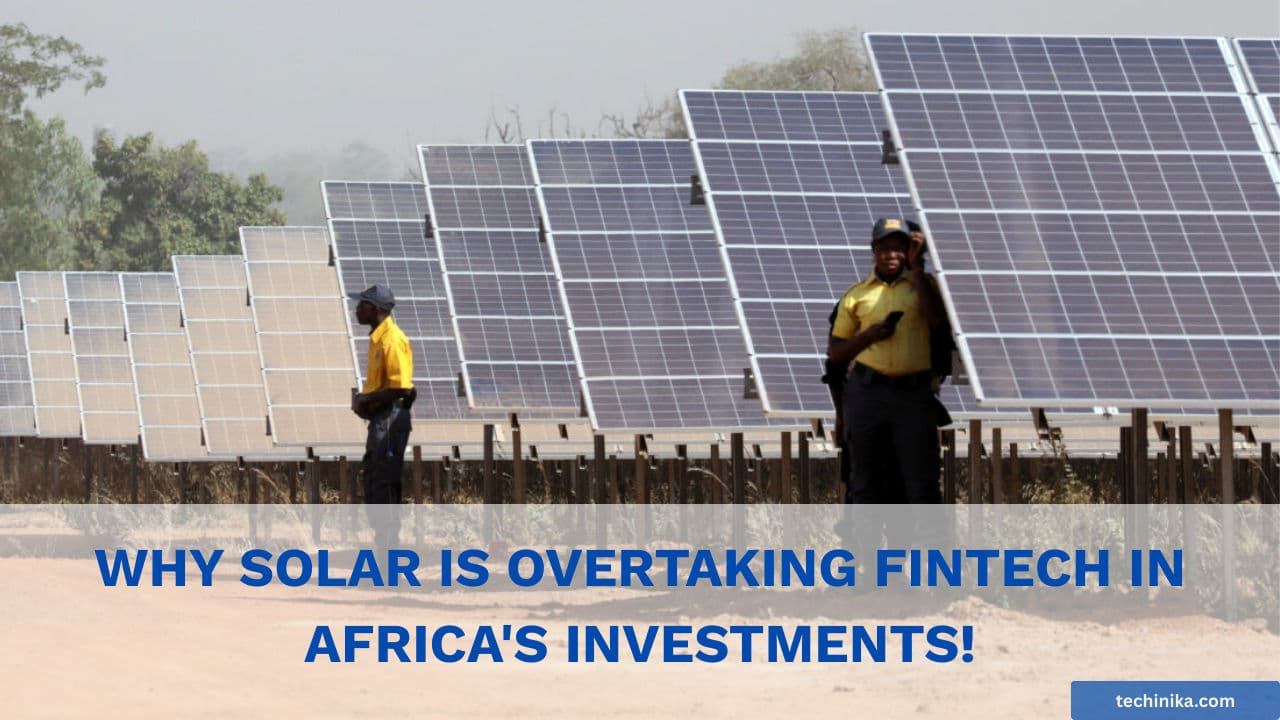
For nearly a decade, Fintech was the undisputed king of African venture capital. But as of January 2026, the data shows a historic shift. According to the latest Africa Investment Reports, funding for Renewables and Cleantech—led primarily by solar—has surged, in some quarters accounting for over 50% of all total investment on the continent.
While Fintech remains a core pillar, the "big money" is moving into hardware and infrastructure. We are witnessing the birth of a "Solar-First" economy where energy isn't just a utility; it's the new foundation for all financial services.
The Infrastructure Deficit
Traditional Fintech (digital payments and wallets) hit a ceiling because it relies on two things that are still unreliable in many parts of Africa: a stable power grid and high smartphone penetration. Investors are moving to Solar because it solves the "Level 0" problem.
Key Drivers of the Shift:
- Asset-Backed Security: Unlike a "pure" software app, solar companies own physical assets (panels, batteries, and bikes). In a fluctuating economy, investors prefer debt-financed, tangible assets. In 2025 alone, debt funding for Cleantech reached $627 million, far outstripping the equity-heavy model of early Fintech.
- The PAYGo Dominance: Pay-As-You-Go (PAYGo) solar sales surged 54% in 2025. This model has officially overtaken cash sales for the first time. It proves that energy isn't being sold as a product anymore; it's being sold as a financial service.
- The "Energy-Poor" Market: With 600 million people still lacking electricity, the market for solar is seen as a "necessity," whereas many fintech apps are seen as "convenience."
The Wrong Question: "Is Fintech Dying?"
The "Wrong Question" many analysts are asking is whether Fintech is losing its relevance. This is a distraction. Fintech isn't dying; it is being absorbed.
The most successful solar companies in Rwanda, Kenya, and Nigeria are now essentially "Solar Banks." They use the data from your energy payments to offer loans for smartphones, electric motorcycles, and school fees. They are using solar as a "Trojan Horse" to enter the financial lives of millions.
The Right Question is: "Who is the regulator when your power company becomes your bank?"
The Future: A Hard-Asset Economy
The shift toward Solar signifies a maturing investment ecosystem. Africa is moving away from "digital-only" hype toward sectors that combine innovation with physical infrastructure.
- Commercial & Industrial (C&I) Growth: Businesses in Egypt, Nigeria, and South Africa are moving off-grid to avoid costly diesel generators and blackouts. This is creating a massive private energy market.
- The Integrated Stack: By 2026, the most valuable companies will be those that control the "Full Stack"; providing the energy (solar), the transport (electric motos), and the finance (mobile money) all in one.
The rise of Solar is a clear message that the future of African investment is about practicality. The "Fintech wave" laid the digital rails, but the "Solar wave" is providing the engine.
Explore more in the Africa Investment Report 2026.
If you enjoyed this article, follow us on WhatsApp for daily tech updates. If you have an idea, need to be featured or need to partner, reach out to us at editorial@techinika.com or use our contact page.
Don't let the story end here.
Share your thoughts, ask questions, and connect with the community.

Kellycie Bayingana
AuthorPassionate about the intersection of technology and storytelling. I am committed to uncovering and sharing the most compelling startup narratives from across Rwanda for Techinika.
View all articles by Kellycie Bayingana →Up Next
What Rwandan Creators Can Learn From Creators Who Built EmpiresBy Cishahayo Songa Achille • 6 min read