WhatsApp Bans General-Purpose AI Chatbots: What It Means for Businesses and Users
AI Quick Summary
- WhatsApp updated its Business API policy, effective January 15, 2026, to ban general-purpose AI chatbots from its platform.
- This change prohibits AI model providers from distributing general-purpose AI assistants through WhatsApp, impacting companies like OpenAI and Perplexity.
- The policy does not affect businesses using AI for customer support or ancillary operations; it targets standalone AI products whose primary functionality is distributed via WhatsApp.
- Meta's rationale includes reducing infrastructure burden, protecting WhatsApp's revenue stream from business messaging, and positioning its own Meta AI as the exclusive general-purpose assistant on the platform.
- Affected AI companies must find alternative distribution channels, while businesses using AI for customer service need to ensure their implementations comply with the new "ancillary" use case.
After the policy took effect, third-party general-purpose AI chatbots were no longer accessible via WhatsApp's Business API, solidifying Meta AI's position as the primary in-app general AI assistant.
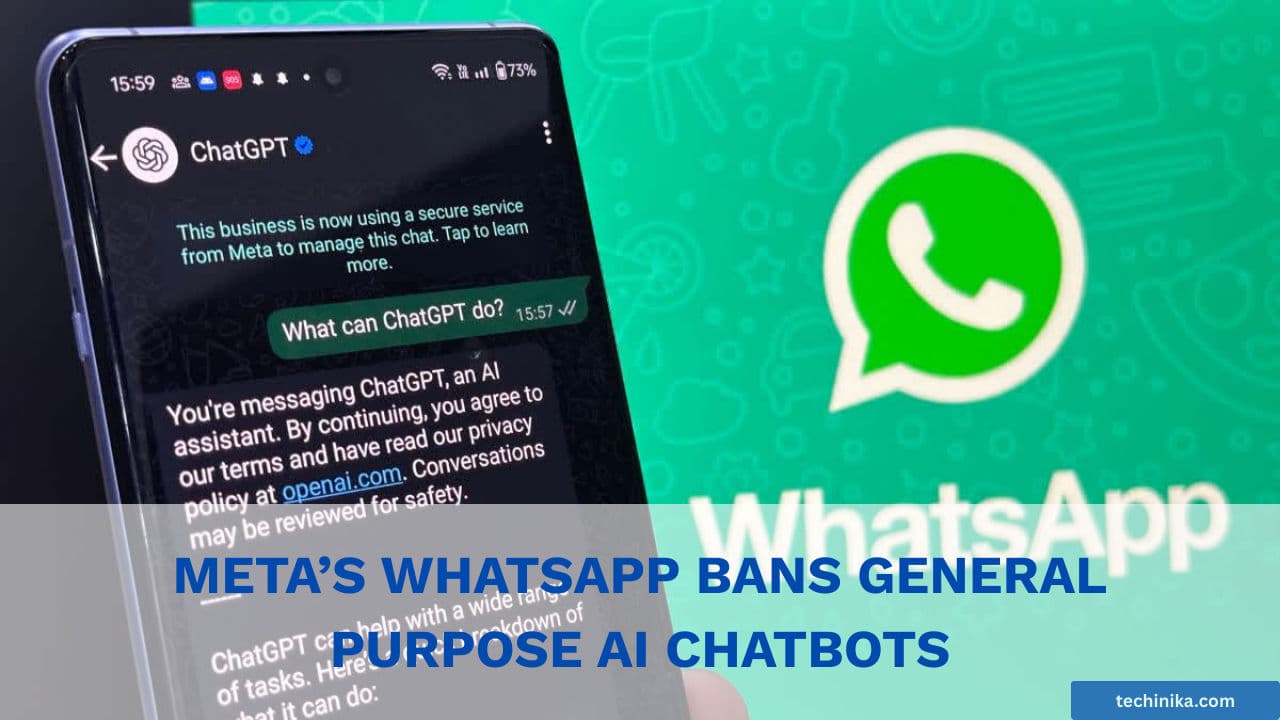
Meta-owned WhatsApp has updated its Business API policy to ban general-purpose AI chatbots from its platform, a move that will affect assistants from companies including OpenAI, Perplexity, Khosla Ventures-backed Luzia, and General Catalyst-backed Poke. The new terms, effective January 15, 2026, prohibit AI model providers from distributing general-purpose AI assistants on WhatsApp's platform, which serves over 3 billion monthly active users.
What Changed in WhatsApp's Policy
WhatsApp has added a new section addressing "AI providers" in its business API terms. The updated policy states that providers and developers of artificial intelligence technologies; including large language models, generative AI platforms, and general-purpose AI assistants, are "strictly prohibited from accessing or using the WhatsApp Business Solution" when such technologies represent the primary functionality being offered.
Critically, Meta confirmed this policy change doesn't affect businesses using AI to serve customers. For instance, a travel company running a customer service bot won't be barred from the service. The distinction lies in whether AI serves as an ancillary tool for business operations or represents the primary product being distributed through WhatsApp.
Companies Affected by the Policy Change
These general-purpose AI assistants had leveraged WhatsApp's massive user base to distribute their services, but will need to find alternative platforms or pivot their strategies by January 2026.
Why Meta Made This Move
Meta's rationale centers on system burden and strategic focus. The company stated that WhatsApp Business API was designed for business-to-business customer service use cases. However, in recent months, general-purpose chatbots emerged as an "unanticipated use case" that placed significant burden on WhatsApp's infrastructure through increased message volumes while requiring different support mechanisms the company wasn't prepared to provide.
There's also a financial dimension. WhatsApp's Business API represents a primary revenue stream for the chat app, charging businesses based on message templates for marketing, utility, authentication, and customer support. Because the API wasn't designed with chatbot distribution in mind, WhatsApp couldn't monetize these AI assistants effectively, meaning companies like OpenAI and Perplexity leveraged WhatsApp's infrastructure without contributing proportionate revenue.
During Meta's Q1 2025 earnings call, CEO Mark Zuckerberg emphasized business messaging as a critical future revenue pillar saying, "WhatsApp now has more than 3 billion monthly active users, with more than 100 million people in the US and growing quickly there... Business messaging should be the next pillar of our business." Allowing third-party AI chatbots to operate freely would undermine this strategic priority.
What This Means for Businesses
Customer Service Bots: Allowed
Businesses using AI to enhance customer support, answer queries, process orders, or provide service updates can continue operating normally. The policy targets general-purpose assistants, not business-specific AI applications.
AI Distribution: Banned
Companies whose primary product is an AI assistant or chatbot cannot use WhatsApp as a distribution channel. This affects startups building standalone AI products relying on WhatsApp's user base.
Meta AI: Exclusive Access
The policy effectively makes Meta AI the only general-purpose assistant available on WhatsApp, eliminating competition from OpenAI, Anthropic, and others within the platform.
Monitoring Required
Businesses must ensure their AI implementations remain "ancillary" to core services. Meta retains "sole discretion" to determine what constitutes primary versus incidental AI functionality.
What Users Can Expect
For WhatsApp's 3 billion users, the immediate impact will be the gradual disappearance of third-party AI assistants they may have been using. OpenAI's ChatGPT on WhatsApp, launched in late 2024, and Perplexity's bot introduced earlier in 2025 both offered capabilities like answering queries, understanding media files, responding to voice notes, and generating images; all accessible directly within WhatsApp without switching apps.
These convenience features will vanish by January 2026, leaving users with two options. Use Meta AI as the only in-app assistant, or leave WhatsApp to access third-party AI tools. For users in regions where Meta AI isn't available or doesn't support local languages well, this represents a significant functionality reduction.
However, users should see no change in how businesses interact with them. Customer service bots from airlines, banks, e-commerce platforms, and other companies will continue functioning normally, as these applications fall within the policy's allowed use cases.
Analysis: Strategic Implications
The Competitive Play: This policy change positions Meta AI as the exclusive general-purpose assistant on WhatsApp while forcing competitors to alternative platforms. It mirrors strategies used by Apple with Siri, Google with Assistant, and Amazon with Alexa; platform owners favoring their own AI products over third-party alternatives.
Revenue Protection: By eliminating free-riding AI assistants that generated massive message volumes without proportionate revenue contribution, Meta protects WhatsApp's business messaging monetization strategy. The company can now focus API pricing on businesses genuinely serving customers rather than subsidizing AI startups' distribution strategies.
Developer Concerns: The policy's "sole discretion" language gives Meta significant power to determine what constitutes acceptable AI usage. This ambiguity may create uncertainty for businesses building AI-enhanced services, potentially chilling innovation for fear of policy violations.
What Businesses Should Do Now
Companies currently using WhatsApp Business API should review their implementations to ensure compliance with the updated terms:
- Assess AI functionality: Determine whether AI in your WhatsApp integration serves as the primary product or an ancillary tool supporting core business operations
- Document use cases: Maintain clear documentation showing how AI enhances customer service rather than functioning as a standalone assistant product
- Monitor communications from Meta: Watch for clarifications on policy interpretation, especially regarding the boundary between allowed and prohibited AI applications
- Plan alternatives: If your business distributes general-purpose AI tools through WhatsApp, develop contingency plans for alternative distribution channels before the January 15, 2026 deadline
- Consider Meta AI integration: Explore whether Meta AI's capabilities could replace third-party AI tools you've been using, as it will remain the only general-purpose assistant option
For AI companies affected by this change; particularly startups that built products leveraging WhatsApp's distribution, the challenge is existential. They must either pivot to alternative platforms like Telegram, LINE, or SMS, or fundamentally rethink their go-to-market strategies. The loss of access to 3 billion users represents a significant setback for AI companies that viewed WhatsApp as critical distribution infrastructure.
Broader Industry Implications
WhatsApp's policy shift reflects broader tensions in the AI ecosystem. As AI capabilities become commoditized and multiple companies offer similar large language model-powered assistants, platform owners face decisions about whether to remain neutral distribution channels or favor their own AI products.
Meta's choice to exclude third-party general-purpose AI while allowing business-specific AI applications creates a precedent other messaging platforms may follow. If Telegram, LINE, WeChat, or other major platforms adopt similar policies, AI startups will face increasingly limited distribution options, potentially consolidating the AI assistant market around a few platform-owned products.
For users, this consolidation means fewer choices and potentially less innovation. Competition between multiple AI assistants on a single platform drives improvements as companies compete for user preference. With only Meta AI available, WhatsApp users lose the ability to choose assistants based on different strengths.
The policy change ultimately reflects a fundamental question facing the tech industry. Will messaging platforms function as open infrastructure where innovation flourishes, or as controlled ecosystems where platform owners dictate which products users can access? Meta's answer, at least for WhatsApp, clearly favors the latter approach, with significant consequences for both businesses and users navigating the evolving AI landscape.
If you enjoyed this article, follow us on WhatsApp for daily tech updates. If you have an idea, need to be featured or need to partner, reach out to us at editorial@techinika.com or use our contact page.
Don't let the story end here.
Share your thoughts, ask questions, and connect with the community.

Cishahayo Songa Achille
Chief EditorCishahayo Songa Achille is a Rwandan software engineer and tech entrepreneur focused on democratizing digital skills. He is best known as the Founder and Managing Director of Techinika, an edtech firm established in 2020 to make complex technological advances accessible to the general public and build solutions for the biggest problems.
View all articles by Cishahayo Songa Achille →