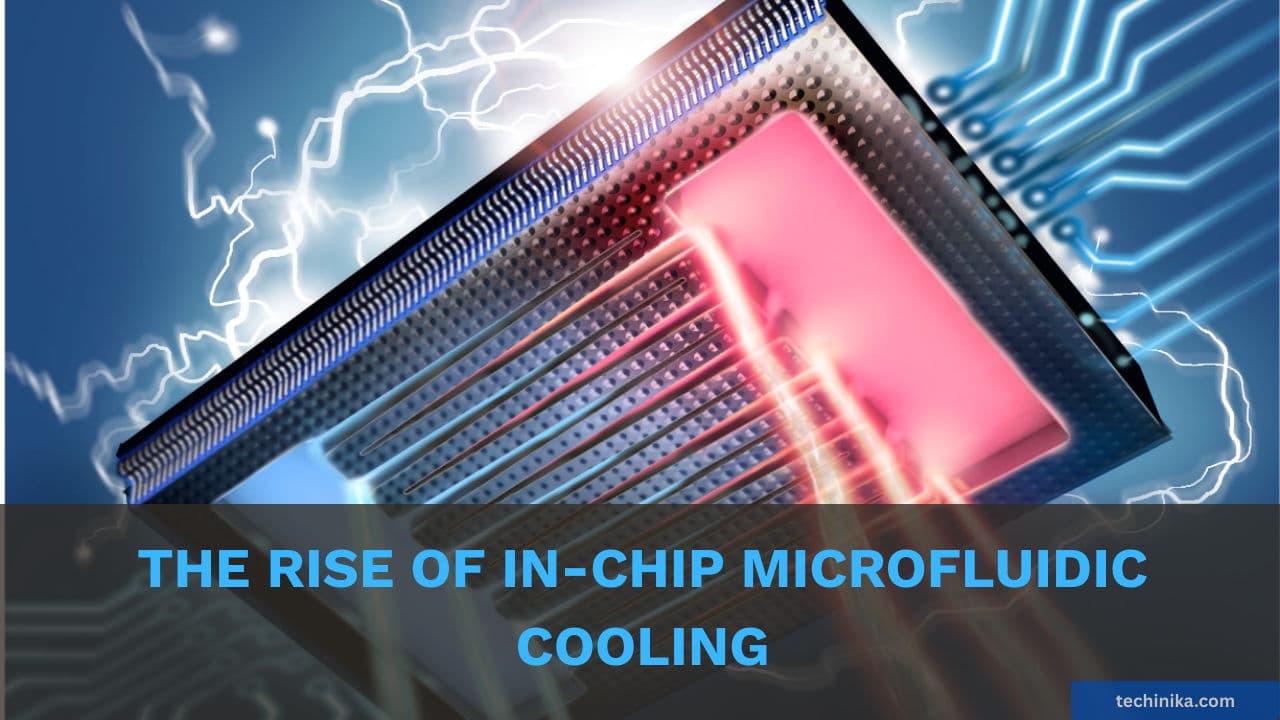
The Rise of In-Chip Microfluidic Cooling
AI Quick Summary
- The "Heat Wall" represents a critical limit in computing, where extreme heat from powerful AI chips causes performance issues and renders traditional cooling methods ineffective.
- Microfluidic cooling is an innovative solution that integrates tiny liquid channels directly within the semiconductor, transforming it into an efficient, internal circulatory system for heat removal.
- This technology, pioneered by EPFL in 2020, has been commercialized by Corintis, which partnered with Microsoft to develop "In-Chip" architectures setting new benchmarks for 2026-grade data centers.
- The system uses sub-micron etching to create hair-width channels, non-conductive dielectric fluids to prevent electrical damage, and bio-inspired fractal designs for uniform temperature distribution.
- Beyond significant performance gains (e.g., 2.4x for 3D-stacked ICs), microfluidic cooling enhances sustainability through waste heat reuse for urban heating and enables advanced applications in space technology.
Since the article's publication in March 2026, the microfluidic cooling market is poised for rapid growth, with Corintis actively scaling its manufacturing capacity to over one million cooling plates annually and continuing to validate its "In-Chip" architectures with major tech companies like Microsoft for high-density AI data centers.
The "Heat Wall" is the terminal physical limit for modern computing. As AI accelerators hit 2,000W per chip, silicon begins to act as a thermal insulator, trapping heat within transistors faster than it can escape. This creates internal hotspots that trigger performance-killing "thermal throttling," rendering traditional fans and cold plates obsolete.
Microfluidic Cooling bypasses this barrier by transforming the semiconductor from a static block into a high-density, circulatory system.
The Industrial Roadmap
Integrated cooling evolved from a 1981 concept into an industrial reality at the IBM Zurich Research Laboratory, proving that internal liquid flow could sustain high-performance clusters. The definitive breakthrough for the AI era originated at EPFL’s Powerlab in September 2020.
There, a team led by Professor Elison Matioli published a landmark Nature study demonstrating that microfluidic channels could be co-fabricated inside the semiconductor alongside the electronics.
This research catalyzed the 2022 founding of Corintis, which partnered with Microsoft to validate "In-Chip" architectures for 2026-grade infrastructure; now the benchmark for data centers facing triple the heat density of previous hardware generations.
The Tech Behind the Flow
Engineering this vascular system requires a move from external conduction to "Intrinsic Thermal Management." The technology functions through three critical layers:
- Sub-Micron Etching: Using Deep-Reactive Ion Etching (DRIE), hair-width channels (~100 micrometers) are carved directly into the backside of the silicon wafer. This brings the coolant within micrometers of the active transistors, removing heat at the source.
- Dielectric Cycles: To eliminate the risk of short-circuits, these systems often use non-conductive dielectric fluids (like 3M Novec). Even a microscopic leak within a $40,000 GPU will not cause electrical damage.
- Bio-Inspired Manifolds: Using AI generative design, the channel layouts mimic leaf venation or butterfly wings. This fractal geometry ensures fresh cold liquid reaches the center of the chip; the logic gates first, maintaining a uniform temperature profile.
Industrial Deployment
Microfluidic systems are now unlocking performance in sectors where thermal density was previously a deal-breaker:
- 3D-Stacked ICs: In 3D architectures, heat is trapped between layers of logic and memory. Microfluidics act as a vertical thermal pillar, pumping fluid through the stack to cool buried layers.
- 2.4x Performance Gains: Recent benchmarks show that 3D-stacked memory processors with microfluidic cooling achieve a 140% increase in performance compared to traditional cooling methods.
- Sustainability & Heat Reuse: Because the heat transfer is so efficient, data centers can use coolant at 60°C to 70°C. This warm-water cooling allows waste heat to be piped directly into city grids for residential heating, turning a cooling problem into a utility.
- Space-Tech and 6G: These etched channels enable high-frequency Gallium Nitride (GaN) amplifiers and orbital AI to survive environments where air-cooling is impossible.
The ice pack era of computing has ended. Hardware performance is no longer limited by transistor count, but by the thermal efficiency of the silicon. By integrating the cooling network into the fabrication process, the industry has stopped fighting the laws of thermodynamics and started partnering with them.
The most capable hardware of the coming decade will be defined not just by its electrical logic, but by the intelligence of its internal flow.
Resources & Further Reading:
If you enjoyed this article, follow us on WhatsApp for daily tech updates. If you have an idea, need to be featured or need to partner, reach out to us at editorial@techinika.com or use our contact page.
Don't let the story end here.
Share your thoughts, ask questions, and connect with the community.

Kellycie Bayingana
AuthorPassionate about the intersection of technology and storytelling. I am committed to uncovering and sharing the most compelling startup narratives from across Rwanda for Techinika.
View all articles by Kellycie Bayingana →