Meet the Top 10: Code for Impact 2025 Finalists Building Rwanda's Tech Future
AI Quick Summary
- The Code for Impact 2025 competition identified ten Rwandan tech projects addressing critical societal challenges in healthcare, agriculture, public safety, and digital accessibility.
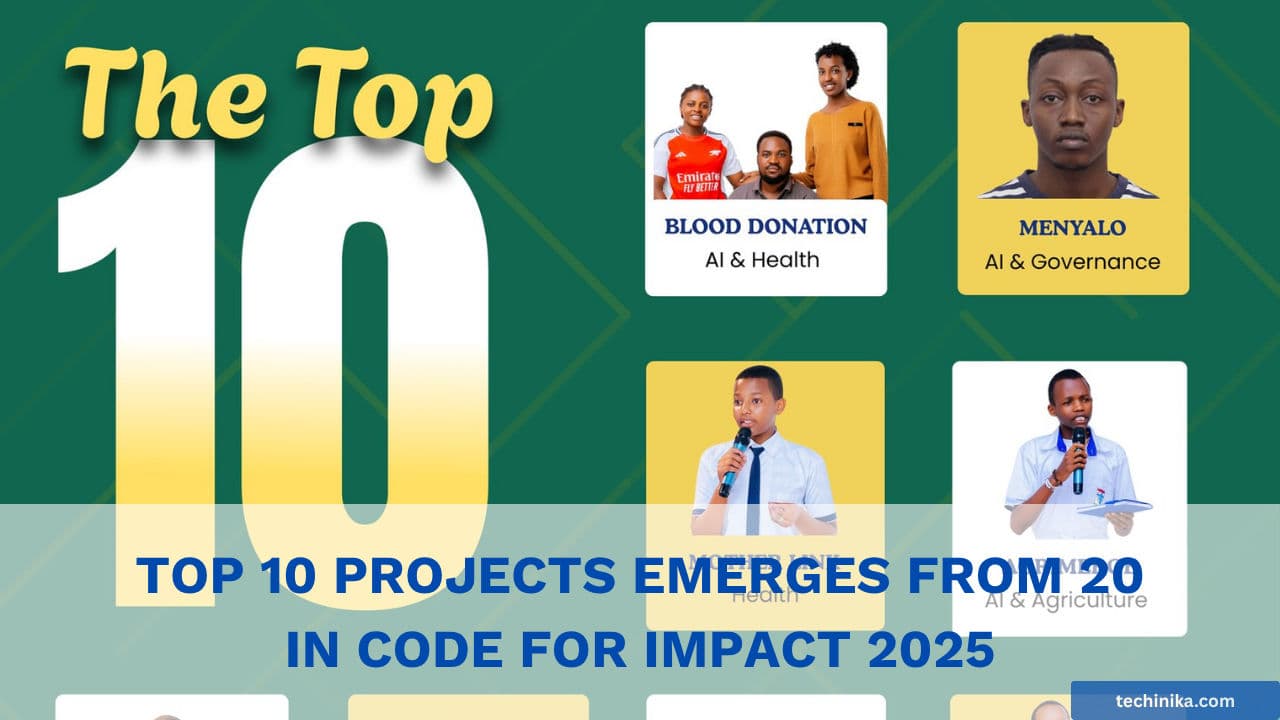
- Finalist projects include Muraho TTS for Kinyarwanda voice technology, L-Guard for motorcycle accident prevention, Seruka for AI-powered travel booking, a Blood Donation System, and Menyalo for legal knowledge access.
- Other notable solutions are Mother Link for maternal health tracking, AgriMerge for linking farmers to markets and crop health, NTDM Animal Hospital for IoT livestock management, NCD Medtech for early detection of non-communicable diseases, and Inkingi Rescue for smartphone-based emergency alerts.
- All top 10 finalists receive free hosting from Megabit and membership to the Rwanda ICT Chamber, offering significant support for their growth.
- These projects demonstrate Rwanda's robust innovation ecosystem, offering deployed and tested solutions that focus on practical problem-solving and immediate impact.
The Grand Finale on November 21, 2025, announced the final rankings, with specific winners receiving additional scaling support, though detailed outcomes of each project's post-competition journey would require further updates.
When the Code for Impact 2025 was launched, the goal was to identify Rwanda's most promising tech solutions addressing real societal challenges. From hundreds of applications, ten exceptional projects have emerged; each tackling critical issues in healthcare, agriculture, public safety, and digital accessibility. These are not just concepts; many are already deployed, saving lives, connecting communities, and demonstrating that Rwanda's innovation ecosystem is producing solutions with immediate, measurable impact.
All top 10 finalists will receive valuable support including free hosting from Megabit and Rwanda ICT Chamber membership. However, the competition intensifies on November 21 at the Grand Finale, where they'll pitch once more to determine final rankings and additional rewards. Here's what each finalist is building:
Muraho TTS: Breaking Language Barriers with Kinyarwanda Voice Technology
Muraho TTS has developed a comprehensive Kinyarwanda text-to-speech platform that goes far beyond simple translation. Their system translates foreign languages into Kinyarwanda, converts sign language, integrates with IoT devices, and provides visual and sign recognition capabilities. What sets them apart is performance; exceptionally low latency, ready-to-use SDKs and APIs, and pay-as-you-go pricing that makes the technology accessible to developers and businesses of all sizes.
The applications are extensive; from voice-driven systems and smart IoT devices to text chatbots that can communicate authentically in Kinyarwanda. For a country working to ensure technology serves all citizens regardless of language ability, Muraho TTS represents critical infrastructure for digital inclusion.
L-Guard: Preventing Motorcycle Accidents with Real-Time Monitoring Pilot Phase
Motorcycle accidents represent a significant public safety challenge in Rwanda's cities. L-Guard addresses this with an IoT device that monitors motorcycle speed, tracks location in real-time, and automatically alerts hospitals, police, and relevant authorities when accidents occur; including severity assessment to ensure appropriate emergency response.
The tool cost $30 per device, L-Guard has been manufactured and will begin pilot testing next week with 10 motorcycles in Kigali. This rapid progression from concept to deployment demonstrates both the team's execution capability and the urgent need for their solution in Rwanda's transportation ecosystem.
Seruka: Simplifying Travel Booking with AI-Powered Recommendations Live
Seruka has built a travel booking platform that aggregates thousands of hotels worldwide and hundreds of airlines, allowing travelers to compare prices and book instantly. What differentiates them is their AI recommendation engine that provides customized suggestions based on individual preferences; turning overwhelming choice into personalized, actionable options.
Unlike many finalists still in development, Seruka is already operational in the market, serving real customers and proving their business model works. Their participation in Code for Impact positions them to scale further and refine features based on user feedback and ecosystem support.
Blood Donation System: Connecting Willing Donors with Life-Saving Opportunities
The inspiration came from a simple encounter. A founder met a Red Cross volunteer collecting blood and realized how many willing donors miss opportunities simply because they lack information about when and where blood is needed. Their solution is a comprehensive system designed for implementation by the Rwanda Biomedical Center (RBC) to address blood shortage challenges.
The platform includes a mobile app for smartphone users, USSD service for rural and non-smartphone populations, and an admin dashboard for RBC to manage requests in real-time. Users can register their willingness to donate, and when blood is needed, the system connects donors with collection points; turning the passive desire to help into active, coordinated life-saving action. As the founders emphasize: "Donating blood means giving life."
Menyalo: Democratizing Legal Knowledge Through Digital Access
Most Rwandans don't know their legal rights and aren't willing to read lengthy PDFs of official gazettes. They want simple answers and digestible information about legal issues they face. Menyalo digitizes Rwanda's legal knowledge, making it easily accessible, readable, and searchable through an intuitive app that transforms complex law into practical guidance.
Beyond individual access, Menyalo creates connections: a community feature allows users to help each other and share legal knowledge, while law firms can use the platform to connect with people seeking professional legal assistance. By bridging the gap between legal expertise and public need, Menyalo addresses a fundamental barrier to justice; awareness of one's rights and available recourse.
Mother Link: Ensuring No Mother or Baby Is Left Behind
In maternal and child healthcare, delays can prove fatal. Mother Link connects mothers, healthcare workers, and hospitals in real-time, enabling health workers to track mothers and babies throughout pregnancy and postpartum periods. The system includes a mobile app, admin dashboard for healthcare facilities, and USSD for communities without smartphone access.
Their scaling strategy include partnering with NGOs already working in maternal health to integrate Mother Link as the digital infrastructure powering their programs. This approach leverages existing trust, relationships, and field presence while adding the coordination and tracking capabilities that can prevent emergencies before they escalate.
AgriMerge: Connecting Farmers to Markets and Crop Health Intelligence
AgriMerge tackles two critical farmer challenges: accessing markets for their produce and detecting crop diseases early. Their integrated AI allows farmers to photograph crops and receive instant diagnosis; identifying problems before they devastate harvests. Simultaneously, the platform connects farmers directly to markets, eliminating middlemen who traditionally capture most value.
The team projects reaching 8,000 users within two years and generating over 45 million Rwandan francs in revenue. Ambitious but achievable targets given agriculture's centrality to Rwanda's economy and the clear pain points they address.
NTDM Animal Hospital: IoT-Powered Livestock Health Management Testing Phase
NTDM Animal Hospital has developed IoT devices currently deployed in Nyagatare tracking livestock health. Their cutting-edge tracking devices and diagnostic tools monitor animals continuously, detect diseases early, and provide veterinary consultation services remotely—bringing professional animal healthcare to rural farming communities that traditionally lack access.
The solution is already proving its value because seven cows are currently being monitored with promising results according to the founder. This real-world testing phase validates both the technology's reliability and farmers' willingness to adopt IoT solutions when they deliver tangible value in animal health and productivity.
NCD Medtech: Early Detection for Non-Communicable Diseases
Non-communicable diseases; cardiovascular conditions, diabetes, and cancer, are rising across Africa, yet rural populations face limited screening access, insufficient diagnostic infrastructure, fragmented reporting systems, and low health literacy. NCD Medtech's Sanitel system addresses these barriers comprehensively through AI-powered screening tools that administer risk assessments, biomarker inputs, and questionnaires.
Machine learning processes this data, stratifies patient risk, and offers clinical guidance. The system integrates automatically with central health information systems, enabling seamless follow-ups, referrals, and tracking across facilities. Real-time dashboards give doctors, hospitals, and policymakers visibility into population health trends, risk hotspots, and resource allocation needs. Automated SMS and call reminders engage patients with medication prompts, appointment reminders, and tailored health education.
Their mission is Detect Early. Act Smart. Live Longer.
Inkingi Rescue: Turning Smartphones Into Life-Saving Alert Systems
In emergencies, seconds matter, but victims often cannot safely call for help. Inkingi Rescue transforms smartphones into intelligent emergency alert systems. When users shake their phones a preset number of times, the app automatically captures video, images, and voice recordings, then sends these with GPS location to authorities.
The system can also alert neighboring users who've opted in, creating community-based emergency response networks. If you witness someone else's emergency, you can report it with evidence through the same system. By combining official emergency response with community support and automatic evidence collection, Inkingi Rescue addresses multiple failure points in current emergency communication systems; particularly valuable in situations where victims cannot safely make phone calls or articulate their location.
What All Finalists Receive
Each of the top 10 teams will benefit from free hosting services provided by Megabit, ensuring their solutions remain accessible and scalable without infrastructure costs becoming barriers. Additionally, all finalists receive Rwanda ICT Chamber membership; opening doors to networking, advocacy support, capacity building programs, and connections to market opportunities and financing that can accelerate their growth beyond the competition.
The Grand Finale Approaches
These ten teams represent Rwanda's innovation ecosystem at its best; solving real problems with practical technology, many already deployed and serving communities. On November 21, they'll pitch one final time to determine who receives additional support to scale their impact.
Learn More About the Grand FinaleWhat stands out across these ten finalists is the diversity of challenges addressed and the maturity of solutions presented. This isn't speculative technology. It is deployed systems with proven results (L-Guard's $30 device), live market products (Seruka's operational platform), and field-tested innovations (NTDM's seven-cow pilot). The common thread is pragmatic problem-solving; identifying pain points, building appropriate technology, and focusing on adoption and impact rather than complexity for its own sake.

Code for Impact has revealed not just individual innovators but an ecosystem reaching critical mass—where technical talent, entrepreneurial ambition, and understanding of local challenges converge to produce solutions Rwanda and Africa urgently need. As these ten teams prepare for their final pitches on November 21, they carry forward not just their own aspirations but proof that Rwanda's investment in ICT infrastructure, education, and innovation support is yielding tangible returns in the form of homegrown solutions to homegrown challenges.
The question the Grand Finale will answer is not which solutions deserve support; all ten clearly do. It is which ones are positioned to scale fastest, impact deepest, and inspire the next generation of Rwandan innovators to see technology not as imported solutions but as tools they can build themselves to transform their communities.
If you enjoyed this article, follow us on WhatsApp for daily tech updates. If you have an idea, need to be featured or need to partner, reach out to us at editorial@techinika.com or use our contact page.
Don't let the story end here.
Share your thoughts, ask questions, and connect with the community.

Cishahayo Songa Achille
Chief EditorCishahayo Songa Achille is a Rwandan software engineer and tech entrepreneur focused on democratizing digital skills. He is best known as the Founder and Managing Director of Techinika, an edtech firm established in 2020 to make complex technological advances accessible to the general public and build solutions for the biggest problems.
View all articles by Cishahayo Songa Achille →Up Next
Hanga Pitchfest Announces Top 45 Startups for 2026 EditionBy Cishahayo Songa Achille • 5 min read