How Origami Math is Solving NASA’s Biggest Launch Puzzles
AI Quick Summary
- Origami Technology uses rigid origami laws to create "intelligent," shape-shifting structures from flat materials like metal, carbon fiber, and DNA.
- The field evolved from traditional craft to industrial applications, leveraging mathematical codes to solve the "Packaging Paradox" for deploying large structures in compact spaces.
- Key technologies include Rigid Origami Kinematics for virtual linkages, Active Triggers using smart materials for self-assembly, and Industrial Origami (e.g., STILFOLD) for robotic sheet metal folding.
- This technology is being deployed across various sectors, including aerospace (lunar habitats, Starshades), biomedical (DNA nanobots for cancer, shape-shifting stents), robotics, logistics, and 6G communication (Reconfigurable Intelligent Surfaces).
- The future vision is "Geometric Sovereignty," shifting from heavy welds to elegant creases, using inherent material intelligence to address global challenges.
Since the article's publication date, significant advancements include STILFOLD expanding its global IP leadership with new US patents for its industrial origami method and NASA continuing to advance its Starshade concept for exoplanet detection, with ongoing testing and development of a hybrid observatory system.
At the intersection of ancient art and computational math lies Origami Technology; a geometric toolkit solving complex engineering challenges. By applying Rigid Origami laws, engineers transform flat sheets of metal, carbon fiber, and DNA into "intelligent," shape-shifting structures designed to expand, contract, and function autonomously.
From Tradition to Industrial Roadmap
The shift from craft to industrial revolution began with the insight that nature uses geometry to pack complex systems into microscopic spaces. This crystallized with Koryo Miura’s invention of the Miura-ori fold, proving that massive surfaces can deploy through a single movement.
Later, pioneers like Robert Lang and Erik Demaine translated these folds into rigorous mathematical code, allowing any 3D shape to be calculated from a single sheet. Today, this solves the "Packaging Paradox," fitting football-field-sized arrays and lunar habitats into rocket fairings or surgical needles without the weight and failure points of traditional mechanical hinges.
The Tech Behind the Crease
We have entered the era of "Kinetic Programming," where mechanical logic is embedded directly into the material:
- Rigid Origami Kinematics: Uses math to concentrate motion into "micro-hinge" creases, allowing rigid materials like titanium to act as virtual linkages without facet deformation.
- Active Triggers & Self-Assembly: Employs Smart Materials that autonomously fold into 3D states via heat, light, or electricity, eliminating manual intervention.
- Industrial Origami (STILFOLD): Combines Digital Crease Fabrication with robotics to fold recycled steel into chassis, removing 70% of traditional parts and welds.
Industrial Deployment and Macro-Assembly
Origami-based systems are scaling across diverse technical sectors:
- Aerospace (Hassell Lunar Plan): ESA’s interlocking 3D-printed modules expand fivefold upon landing to create radiation-shielded habitats.
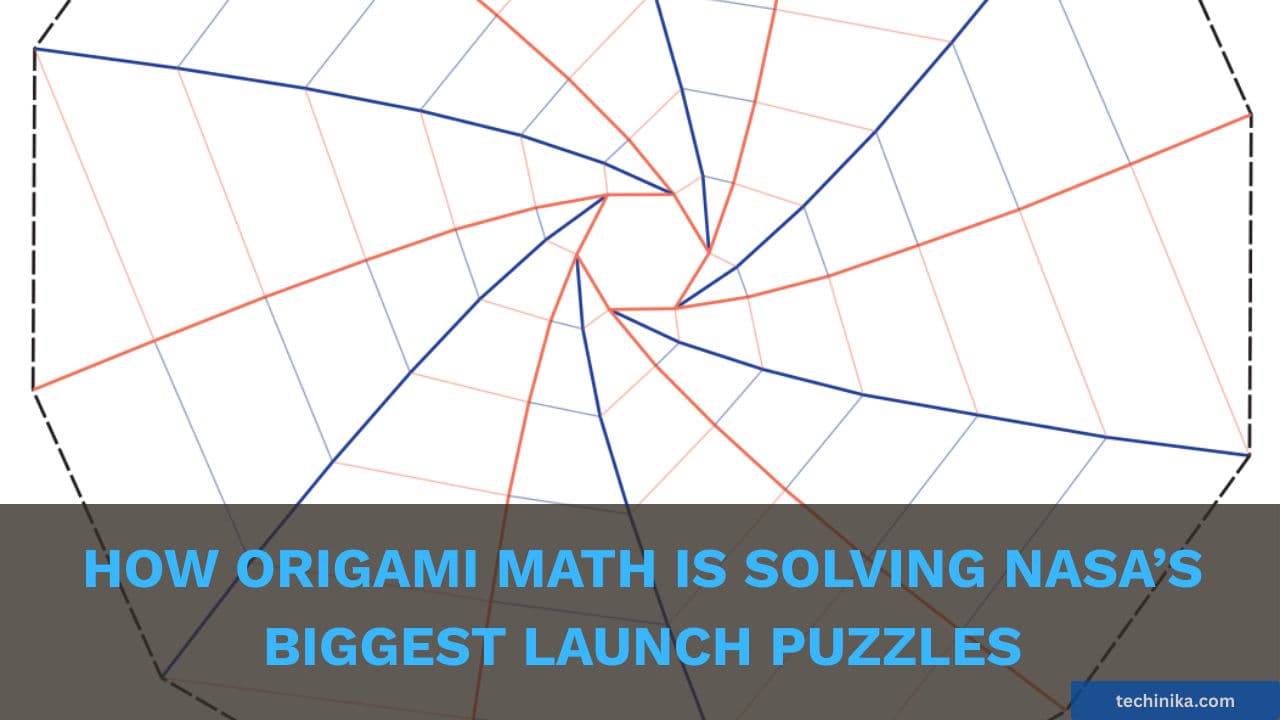
- Deep Space (NASA Starshades): 26-meter shields utilize the "Flasher" pattern to wrap baseball-diamond-sized structures into 4-meter rocket cones with sub-millimeter precision.
- Biomedical (DNA Nanobots): DNA strands folded into Boolean logic boxes remain locked in the bloodstream, unfolding only when they detect specific cancer biomarkers.
- Cardiovascular (Shape-Shifting Stents): Waterbomb and cylinder geometries provide extreme compression for needle-based delivery and high radial strength for arterial support.
- Robotics (Physical AI): "Insect Robots" integrate sensing into functional sheets, navigating and jumping via light-reactive snapping beams rather than electronics.
- Surgery (Magnetic Muscles): Magnetic "muscles" on Miura-ori structures allow surgical millirobots to be steered wirelessly to deliver medicine to damaged tissue.
- Logistics (Sustainable Packaging): The FOLD Project turns recycled cardboard into shock-absorbing metamaterials, cutting material use by 40%.
- 6G (Origami RIS): MWC Barcelona showcased Reconfigurable Intelligent Surfaces (RIS) that tilt internal folds in real-time to steer signals around urban obstacles and eliminate dead zones.
The story of origami technology is one of a world that no longer sits still. We are entering the era of Geometric Sovereignty, where everything from kinetic city facades to microscopic medical envelopes revolves around the logic of the fold.
By abandoning heavy welds for elegant creases, we have stopped forcing materials into static shapes and started partnering with the natural laws of motion. Looking ahead, the solutions to our greatest global challenges won't come from bigger machines, but from unfolding the intelligence hidden within a single, perfect sheet.
Read more:
If you enjoyed this article, follow us on WhatsApp for daily tech updates. If you have an idea, need to be featured or need to partner, reach out to us at editorial@techinika.com or use our contact page.
Don't let the story end here.
Share your thoughts, ask questions, and connect with the community.

Kellycie Bayingana
AuthorPassionate about the intersection of technology and storytelling. I am committed to uncovering and sharing the most compelling startup narratives from across Rwanda for Techinika.
View all articles by Kellycie Bayingana →