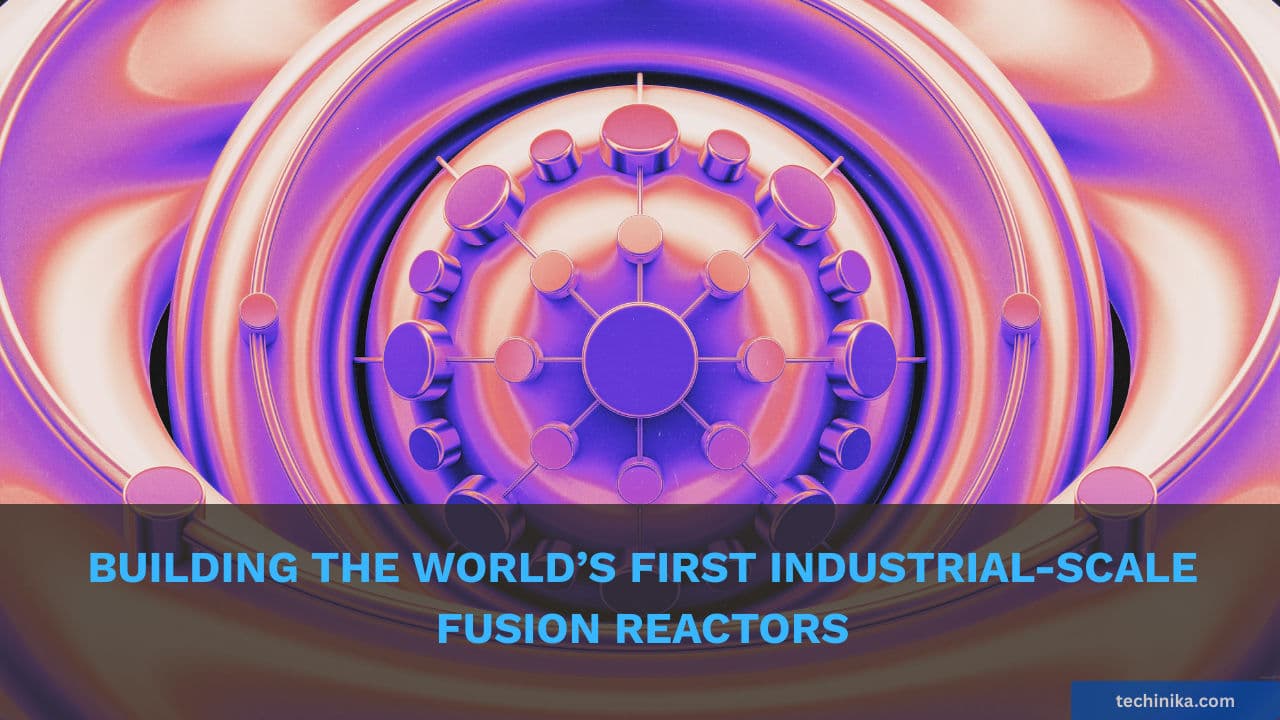
Building the World’s First Industrial-Scale Fusion Reactors
AI Quick Summary
- The fusion energy sector has transitioned from scientific experiments to building industrial-scale infrastructure with the launch of Commercial Fusion Foundries.
- These foundries are designed to convert 100-million-degree plasma into stable, high-quality electricity using advanced components like High-Temperature Superconducting Magnets and Modular Tokamak Cores.
- The urgency for fusion energy is driven by the need for "Energy Sovereignty" and a projected 40% increase in global energy demand by 2030.
- Fusion offers solutions by providing massive power independent of geopolitical fuel shocks, delivering "Always-On" baseload electricity for high-tech industries, and enabling industrial reshoring due to low energy costs.
- The immediate goal is Grid Injection for industrial sites, with the long-term vision of establishing a new energy security paradigm based on fusion's high energy density.
Shortly after this article, Germany officially entered the commercial fusion race in early March 2026, with Proxima Fusion partnering to build a stellarator fusion power plant for grid connection by the 2030s.
While much of the global energy conversation focuses on theoretical breakthroughs, the transition to the hardware-first era of fusion energy is now a matter of industrial record. Across specialized campuses from Massachusetts to newly zoned facilities, fusion, the process of replicating solar physics; has officially moved from lab experiments to industrial-scale infrastructure.
We are witnessing the launch of the world’s first Commercial Fusion Foundries, built to tackle the single greatest challenge in the energy race: converting 100-million-degree plasma into stable, high-quality electricity.
What Exactly Makes Fusion Technology?
Fusion isn’t just science; it’s a complex engineering platform. The technology blends extreme physics with practical design to control and harness plasma safely. The core systems include:
- High-Temperature Superconducting Magnets (HTS): These generate magnetic fields far stronger than conventional systems, forming the invisible “cage” that contains and stabilizes plasma.
- Modular Tokamak Cores: Precision-built reactors where fusion reactions occur, engineered to endure extreme heat and neutron bombardment.
- Thermal Conversion Systems: Specialized structures that transform the energy from high-speed particles into usable heat and electricity.
- Control & Monitoring Hardware: Advanced sensors, real-time computing, and automation keep plasma stable and the reactor safe, operating in conditions no ordinary machine could withstand.
Why It Matters Now
The shift toward fusion is driven by a critical need for Energy Sovereignty. As global grids face a 40% surge in demand by 2030, traditional intermittent sources (like wind and solar) and finite resources (like gas) are hitting a ceiling. Fusion provides the "Deep Tech" solution to three industrial bottlenecks:
- Decoupling Growth from Resources: For the first time, a nation can produce massive power without being vulnerable to geopolitical fuel shocks. One gram of fusion fuel provides the energy of 11 tons of coal, effectively turning energy into a manufactured product rather than a harvested resource.
- Baseload Resilience for High-Tech Hubs: Unlike weather-dependent renewables, fusion delivers "Always-On" power. This is the only carbon-free technology capable of supporting the massive, 24/7 loads required by modern industrial zones and high-density data campuses.
- Industrial Reshoring: By lowering the "energy overhead" to nearly zero over time, fusion allows energy-intensive manufacturing to move closer to home, shortening supply chains and stabilizing local economies against global inflation.
The real impact of this Fusion Foundry begins where the construction ends. We are now moving into the critical phase of Grid Injection, with industrial and hyperscale sites as the first major goldmines. But the roadmap goes beyond just electricity; it’s about a fundamentally new paradigm for energy security. The future of the Foundry lies in its energy density: one gram of fusion fuel provides the same power as 11 tons of coal.
By bridging the gap between extreme physics and the local plug, these companies are ensuring that the world finally has a permanent, high-output pulse.reliable. The era of industrial fusion is here, and it is no longer just a scientific milestone; it is a functioning energy platform shaping the power landscape.
Read more:
If you enjoyed this article, follow us on WhatsApp for daily tech updates. If you have an idea, need to be featured or need to partner, reach out to us at editorial@techinika.com or use our contact page.
Don't let the story end here.
Share your thoughts, ask questions, and connect with the community.

Kellycie Bayingana
AuthorPassionate about the intersection of technology and storytelling. I am committed to uncovering and sharing the most compelling startup narratives from across Rwanda for Techinika.
View all articles by Kellycie Bayingana →