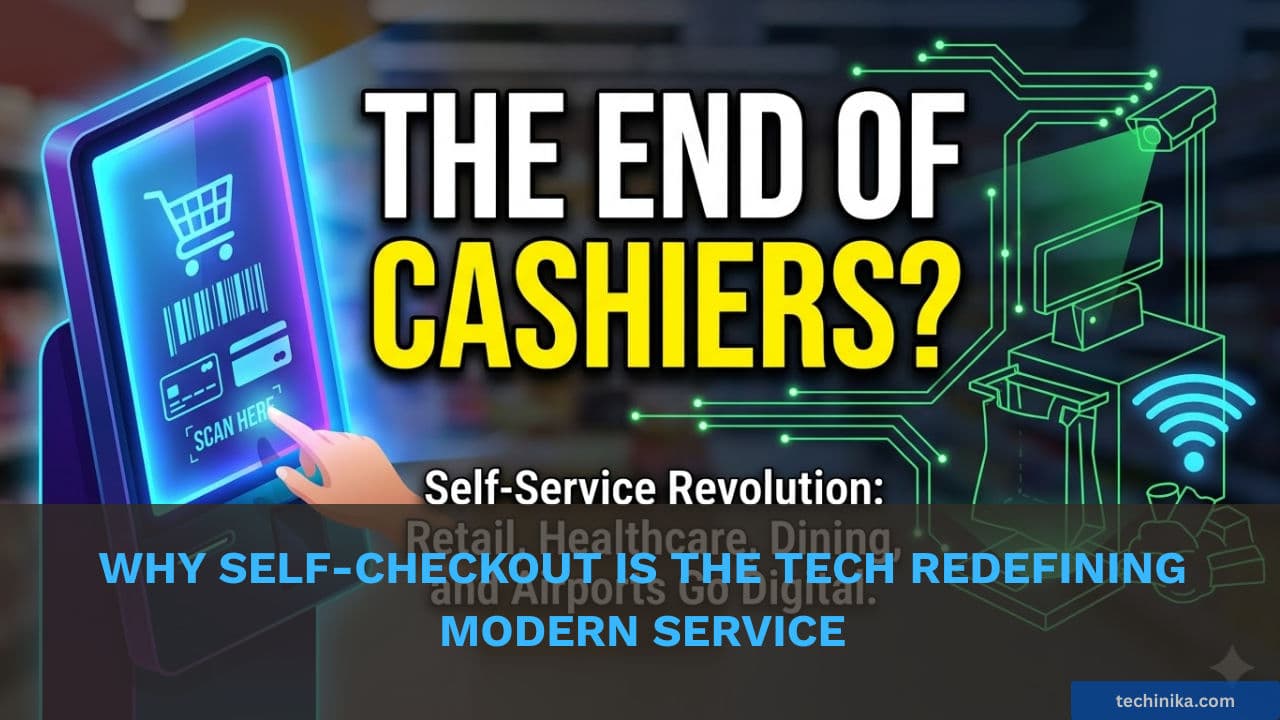
Why Self-Checkout is The Tech Redefining Modern Service
AI Quick Summary
- The world is shifting towards self-service, moving from human interaction to empowering customers through interfaces, initially to solve "retail bottlenecks."
- Dr. Howard Schneider pioneered self-service with the "Service-Plus" system in the 1980s to process more customers without increasing staff, now a global standard.
- Modern self-service systems rely on advanced technologies like Computer Vision & AI, IoT Weight Sensors, RFID, and Integrated Payments for efficiency and security.
- The self-service model has expanded beyond retail into hospitality, aviation, healthcare, and dining, transforming customer interactions across various industries.
- While offering speed and convenience, self-service faces challenges such as hardware failures, AI surveillance concerns, and significant financial losses due to theft ("shrink"), leading some retailers to scale back.
Ongoing developments in self-service technology are focusing on enhancing security measures and improving user experience to mitigate issues like theft and hardware malfunctions, while expanding into new sectors like smart infrastructure.
We are living through a fundamental shift in how we interact with the world around us. The physical distance between a business and its customer is shrinking, replaced by high-definition glass and laser scanners.
What started as a niche experiment in retail has scaled into a global standard for the service industry. We have entered an era where service no longer means being helped by a person; it means being empowered by an interface.
The Origin and Logic of the Automated Lane
Self-service was pioneered by innovators like Dr. Howard Schneider, who developed the "Service-Plus" system in the 1980s. The invention was born out of a specific frustration known as the "retail bottleneck" because stores were losing money when customers abandoned full carts rather than wait in long lines.
His goal was to create a release valve for these queues, allowing the store to process more people without needing to hire more staff. Today, these systems are used by millions daily, evolving from an optional convenience into the standard gateway for almost every commercial transaction.
For the user, the appeal is the ability to manage their own checkout process without the pressure of a person waiting on them or a cashier rushing their items.
The Tech Powering the System
Modern self-service replaces the human cashier with a sophisticated layer of sensory hardware and intelligent software:
- Computer Vision & AI: Real-time camera arrays identify items instantly, removing the need to manually search menus for unbranded produce like fruits and vegetables.
- IoT Weight Sensors: Precision scales in the bagging area act as a security checkpoint, cross-referencing the weight of every scanned item to detect errors or mismatches.
- RFID (Radio Frequency Identification): High-speed sensors in retail and libraries scan entire stacks of items simultaneously, eliminating the need to find and scan individual barcodes.
- Integrated Payments: Frictionless hubs support everything from NFC and Apple Pay to mobile money platforms like MTN MoMo, syncing the transaction with the scan.
The End of the Counter
The logic of the automated lane has migrated far beyond the supermarket, becoming the new operating system for modern infrastructure:
- Hospitality: Self-service zones are replacing hotel front desks, allowing travelers to verify IDs and cut their own RFID room keys in seconds.
- Aviation: Airports have offloaded the check-in process to digital networks where passengers manage seat selection and automated baggage induction.
- Healthcare: Clinic waiting rooms now utilize digital intake tablets to verify insurance and process co-pays before a patient ever sees a provider.
- Dining: Fast-food models have shifted staff to the kitchen, transforming the front of the house into a digital ordering interface managed entirely by the customer.
Speed vs. Accountability
While this shift is a powerful solution to the "checkout clog," it forces a difficult trade-off between speed and accountability. As we move toward a "frictionless" world, we face new frustrations like hardware failure and the invasive gaze of AI surveillance cameras. Perhaps the most significant hurdle is that these stations have become a "thief magnet," causing massive financial losses known as "shrink."
This has forced many retailers to scale back as the cost of theft begins to outweigh the savings on labor. Even with these complications, the technology is fundamentally making life easier by removing the traditional barriers to entry and speed in commerce. The success of these systems depends on finding a balance where they truly simplify the user's day rather than just offloading the store's work onto the customer at their own expense.
If you enjoyed this article, follow us on WhatsApp for daily tech updates. If you have an idea, need to be featured or need to partner, reach out to us at editorial@techinika.com or use our contact page.
Don't let the story end here.
Share your thoughts, ask questions, and connect with the community.

Kellycie Bayingana
AuthorPassionate about the intersection of technology and storytelling. I am committed to uncovering and sharing the most compelling startup narratives from across Rwanda for Techinika.
View all articles by Kellycie Bayingana →