How MirrorMe Solved the Hardware Bottlenecks of Humanoid Sprinting
AI Quick Summary
- MirrorMe Technology and Zhejiang University unveiled "Bolt," a full-size humanoid robot, shifting the robotics goal from human-level mimicry to creating a "Super-Species."
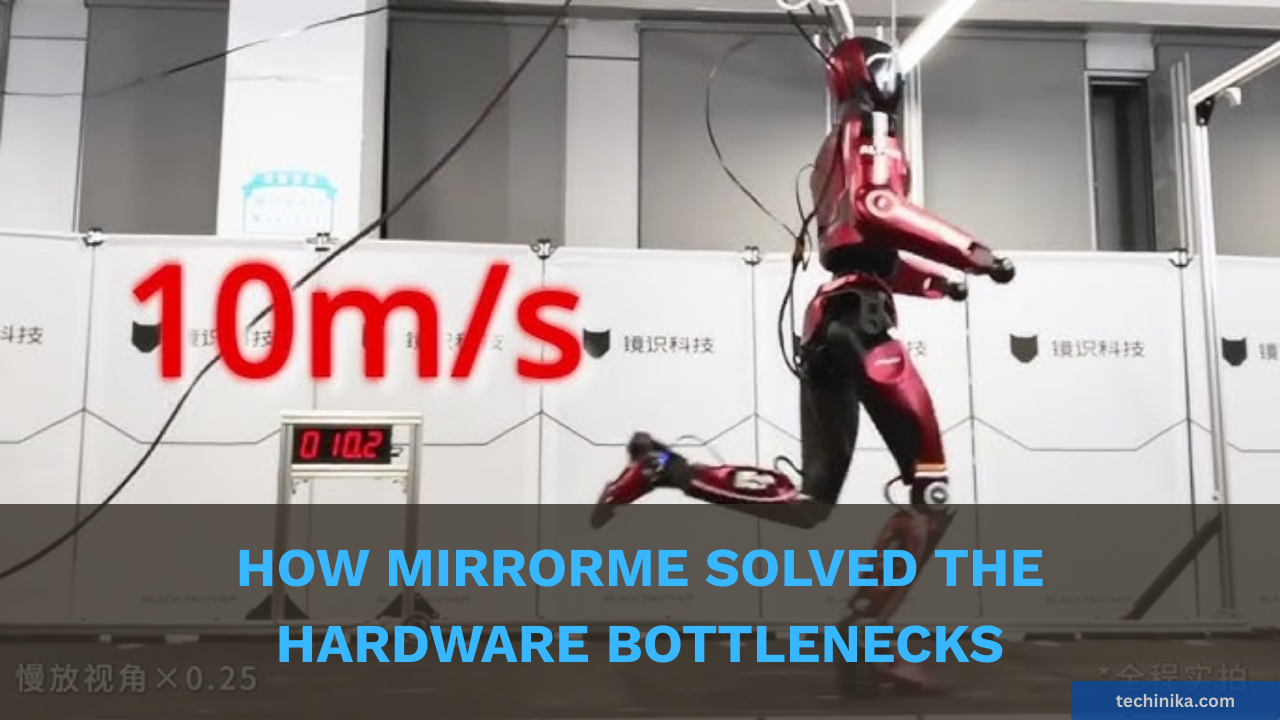
- Bolt achieved a record-breaking speed of 10 meters per second (approximately 22.4 mph), making it the fastest full-size humanoid in history and surpassing human sprinting capabilities.
- The robot, measuring 175cm tall and weighing 75kg, is engineered as an "ideal form" focusing on raw, high-performance integration of hardware and motion perception.
- Its "Super-Species" hardware includes custom high-torque actuators, a high-frequency cadence for stability, and integrated zero-latency feedback sensors to handle extreme forces.
- MirrorMe envisions Bolt as a "Steel Sparring Partner" for professional athletes, providing a tireless rival to help them break through biological plateaus by simulating record-breaking paces.
As of February 5, 2026, Bolt remained confined to the lab, despite its ability to outpace nearly all human runners.
For decades, the robotics industry has been locked in a race to build the "perfect mimic"; machines that walk, talk, and move exactly like us. But on February 2, 2026, MirrorMe Technology and Zhejiang University officially declared that "human-level" is no longer the goal.
With the global unveiling of Bolt, a full-size humanoid that clocked a record-breaking 10 meters per second (roughly 22.4 mph), MirrorMe introduced a new governing philosophy: the creation of a "Super-Species." This isn't just a robot designed to help humans; it’s a machine engineered to surpass the biological bottlenecks of the human frame.
The Engineering of the "Ideal Form"
Standing 175cm tall and weighing 75kg, Bolt is what MirrorMe calls the "ideal form" of a humanoid. While other companies prioritize the "mind"; building AI that can sort laundry or navigate a warehouse; MirrorMe focuses on the raw, high-performance integration of hardware and motion perception.
To prove Bolt’s status as a super-species, MirrorMe founder Wang Hongtao; a professor at Zhejiang University and an alumnus of Tsinghua and Harvard; personally stepped onto a treadmill to race the red-painted android. While the human sprinter eventually peaked, Bolt continued to accelerate, maintaining a relentless mechanical cadence that makes it the fastest full-size humanoid in history.
"Super-Species" Hardware
Building a robot that runs at 10 m/s is a violent physical act. Most humanoid joints would simply melt or shatter under the torque required to propel 75kg at 22 mph.
- Power Density: Bolt utilizes custom, high-torque actuators evolved from the Black Panther II quadruped, which hit a staggering 13.4 m/s in 2025. These drives allow for explosive power output while absorbing ground-impact forces that are double the robot's body weight with every stride.
- Cadence as a Stabilizer: Unlike human sprinters who rely on long, powerful strides, Bolt utilizes a high-frequency cadence. By taking more steps per second, its flight controller can make micro-adjustments to its balance hundreds of times per second.
- Zero-Latency Feedback: Sensors are integrated directly into the motor housings, allowing the hardware to "feel" the surface and adjust torque in real-time, bypassing the processing lag that typically causes other robots to stumble at high speeds.
The "Steel Sparring Partner"
MirrorMe’s vision for a super-species goes beyond laboratory records. They aim to endow machines with movement and manipulation capabilities that exceed human limits to serve as a "Steel Sparring Partner."
The objective is to provide professional athletes with a training rival that can perfectly and consistently simulate the record-breaking paces of legends like Usain Bolt or current world-beaters like Noah Lyles. By training against a partner that never tires and can maintain an unwavering 9.6-second 100m pace, athletes can push past biological plateaus that are impossible to replicate in traditional human-to-human training.
MirrorMe Technology isn't just building a faster robot; they are redefining the boundaries of what a physical body—organic or mechanical—can achieve. By mastering high-torque physics and super-human balance, they have moved the humanoid from the factory floor to the world's most elite athletic tracks.
Read more about the developer's journey: MirrorMe Technology.
If you enjoyed this article, follow us on WhatsApp for daily tech updates. If you have an idea, need to be featured or need to partner, reach out to us at editorial@techinika.com or use our contact page.
Don't let the story end here.
Share your thoughts, ask questions, and connect with the community.

Kellycie Bayingana
AuthorPassionate about the intersection of technology and storytelling. I am committed to uncovering and sharing the most compelling startup narratives from across Rwanda for Techinika.
View all articles by Kellycie Bayingana →