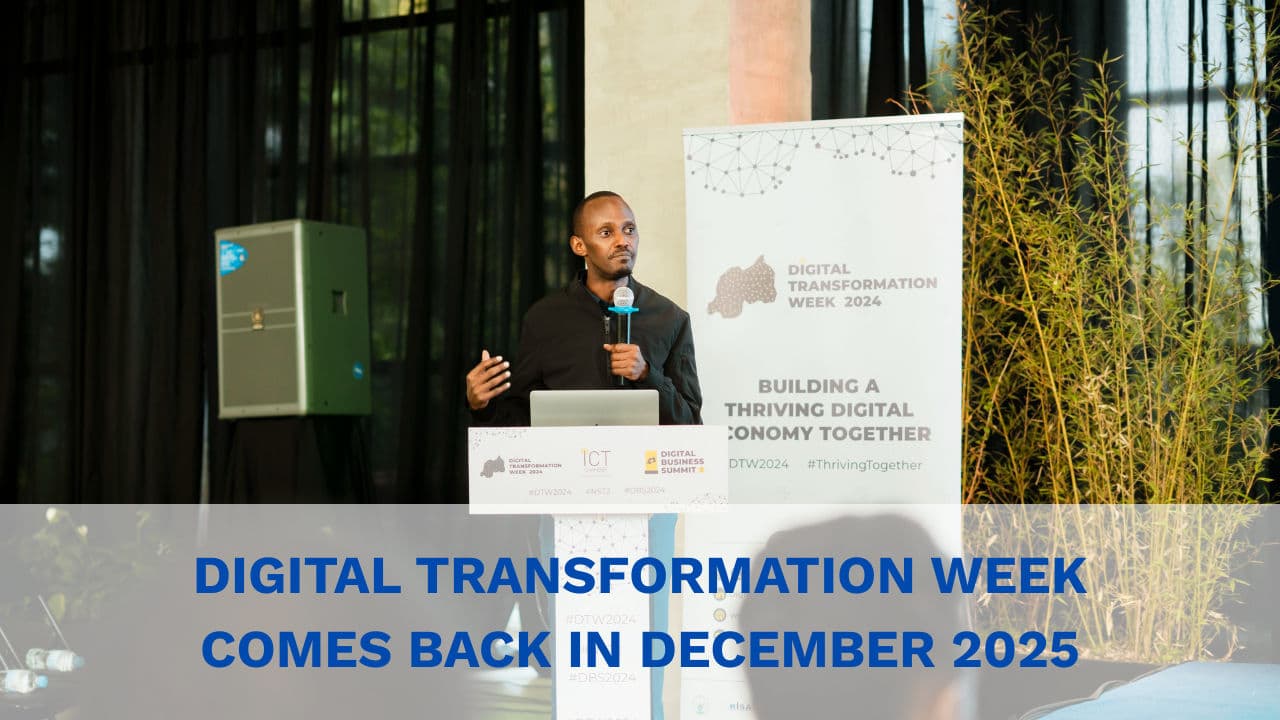
Digital Transformation Week Returns to Rwanda December 15-19, 2025
AI Quick Summary
- Rwanda is hosting its flagship Digital Transformation Week (DTW) 2025 from December 15-19 in Kigali and various districts, aiming to gather over 10,000 participants to advance its digital agenda.
- The 2025 event aligns with Rwanda's National Strategy for Transformation 2 (NST2, 2024-2029), focusing on accelerating digital transformation, promoting inclusion, and enhancing digital service delivery.
- NST2 sets ambitious targets, including achieving 100% end-to-end digital government services and providing every citizen with a unique digital identity by 2030, alongside raising digital literacy to 80% by 2027.
- Rwanda has shown significant digital progress with an 8% average economic growth driven by technology, high mobile broadband coverage, and platforms like IremboGov, Tap & Go, and Zipline.
- Despite progress, challenges remain, including a digital literacy rate of 53%, less than 40% smartphone ownership, and the need for enhanced digital skills for approximately five million Rwandans.
After the article was written, Rwanda successfully held its Digital Transformation Week 2025, which emphasized job creation and digital skills, and the country also launched a Digital FDI report to boost foreign investment and received global recognition for its advancements in digital governance.
Rwanda's flagship Digital Transformation Week (DTW) returns for its 2025 edition from December 15 to 19, bringing together over 10,000 participants from across the globe to advance the nation's digital agenda. Organized by the Rwanda ICT Chamber, Rwanda Information Society Authority (RISA), and the Ministry of ICT and Innovation, the event will be hosted in Kigali and multiple districts including Muhanga, Huye, Rusizi, Rubavu, and Nyagatare.
DTW 2025: Aligned with National Strategy
The 2025 edition centers on three strategic pillars aligned with Rwanda's National Strategy for Transformation 2 (NST2, 2024-2029): accelerating digital transformation, promoting digital inclusion, and enhancing digital service delivery. NST2 sets ambitious targets for 2030, including achieving 100 percent end-to-end digital government services and providing every citizen with a unique digital identity.

The week-long celebration will engage local and international techpreneurs, regulators, tech companies, startups, tech enthusiasts, citizens, and netizens in discussions, exhibitions, and collaborative sessions aimed at positioning Rwanda as a regional digital innovation hub.
DTW 2024: A Year of Connection and Collaboration
The 2024 edition of Digital Transformation Week focused on unpacking ICT Sector priorities under NST2 and positioning Rwanda as a regional hub for digital innovation. It was conducted under the theme “Building A Thriving Digital Economy Together”, the DTW 2024 brought together 1,000+ tech entrepreneurs, ICT sector regulators, development partners and the general public through series of summits, workshops, roundups, and hands-on sessions as well as media engagement dedicated to helping organizations and individuals understand, adapt to, and leverage digital transformation across Rwanda.
DTW 2024 served as both a reflection of Rwanda's progress and a call to action to continue building a digitally inclusive and knowledge-based economy. The event featured candid moments captured through smiling participants, interactive exhibition booths, and powerful exchanges of ideas that reflected the true spirit of collaboration behind Rwanda's digital journey.
Insights from DTW 2024 Leaders
Several prominent voices shaped the discourse at DTW 2024, offering perspectives on Rwanda's digital trajectory:
"A thriving digital economy starts with us. We've made great progress from driving growth in tourism and services to contributing 3% to our national GDP. But we must aim higher."
"The progress we've made in recent years shows that when government, private sector, and innovators work together, transformation becomes possible. Our goal is to ensure that every startup, every entrepreneur, and every Rwandan can benefit from digital opportunities."

"Broadening Rwanda's digital horizons means leaving no one behind. Together, we're shaping a future where every Rwandan benefits from digital transformation."
"Collaboration is key to building a stronger ICT sector. We must come together, not just in vision but in action—forming joint companies by 2025, embracing crowdfunding, and building systems that support innovation."
Reaching Beyond Kigali: Hanga Hubs Tour
The DTW 2024 tour and mixer sessions carried the message of digital transformation across Rwanda, from Rubavu to Nyagatare, Rusizi, and the Rwanda Coding Academy. By promoting digital literacy and innovation beyond Kigali, these hubs empowered over 2,000 young people and entrepreneurs to drive change in their communities.
According to FurtherAfrica's September 2024 report, Rwanda has averaged 8 percent economic growth per annum over the past two decades, largely driven by innovative technology use. The country's booming tech sector and commitment to innovation have propelled it to the forefront of Africa's digital revolution.
Rwanda's Digital Transformation Context
Research shows that Rwanda's digitalization efforts are driven by IremboGov, an integrated e-government platform providing access to over 100 essential services. Launched in 2015, IremboGov has become the backbone of Rwanda's digital transformation strategy, offering services in family affairs, immigration, health, education, taxation, and land management.
Substantial public investment in digital infrastructure and enabling regulatory reforms have helped Rwanda achieve some of the highest 3G and 4G network coverage rates on the continent. By November 2024, mobile internet subscribers numbered over 13 million from 7 million in 2019, RURA report shows.
Addressing Digital Inclusion Challenges
Despite impressive progress, challenges remain. The 2024 United Nations E-Government Development Index shows Rwanda's score improved from 0.55 in 2022 to 0.58 in 2024, but this remains below the African average of 0.86. The Ministry of ICT and Innovation estimates that five million Rwandans require enhanced digital skills to interact effectively with digital platforms.
The government aims to raise digital literacy from 53 percent to 80 percent by 2027, targeting universal digital literacy by 2030. Despite 99 percent mobile broadband coverage, less than 50 percent of Rwandans use mobile internet, and also less than 40 percent own smartphones—significantly lower than the Sub-Saharan Africa average of 49 percent.
NST2 Ambitious Digital Targets
According to Interweave's analysis, NST2 focuses on establishing Rwanda as a globally competitive and knowledge-based economy. The strategy emphasizes digitalization as key to innovation and job creation, building on NST1's (2017-2024) foundation of strengthening institutional capacity and improving service efficiency.
Technology Applications Driving Change
FurtherAfrica reports that Rwanda's transformation extends across multiple sectors. AC Group's Tap & Go system, introduced in 2015, allows public transport commuters to pay electronically, revolutionizing the sector with transparency and efficiency.

In healthcare logistics, Zipline operates the world's largest autonomous delivery system from Rwanda, delivering medical supplies including blood to remote areas in under 40 minutes.
Positioning as Africa's Digital Hub
In 2022, Rwanda became one of 16 countries to host a World Economic Forum Centre for the Fourth Industrial Revolution, working to promote emerging technologies including artificial intelligence, machine learning, blockchain, and the Internet of Things.
Looking Forward to DTW 2025
As DTW 2025 approaches, the event promises to build on 2024's success with expanded regional participation, bringing the digital transformation conversation to districts across Rwanda. The multi-location format ensures that the benefits of digital knowledge-sharing and networking extend beyond the capital.
The event's timing aligns with critical junctures in Rwanda's digital journey: as the country launches over 200 additional e-services and works toward its 2030 targets, DTW 2025 will serve as a platform for stakeholders to collaborate, innovate, and chart the path forward for Rwanda's digital economy.
If you enjoyed this article, follow us on WhatsApp for daily tech updates. If you have an idea, need to be featured or need to partner, reach out to us at editorial@techinika.com or use our contact page.
Don't let the story end here.
Share your thoughts, ask questions, and connect with the community.

Cishahayo Songa Achille
Chief EditorCishahayo Songa Achille is a Rwandan software engineer and tech entrepreneur focused on democratizing digital skills. He is best known as the Founder and Managing Director of Techinika, an edtech firm established in 2020 to make complex technological advances accessible to the general public and build solutions for the biggest problems.
View all articles by Cishahayo Songa Achille →