China's 'Are You Dead?' App Goes Viral, Exposing Loneliness Crisis Among Solo Dwellers
AI Quick Summary
- A safety app named "Sileme" (Are You Dead?) rapidly topped China's App Store charts by asking users to check in daily, triggering emergency contacts if two consecutive days were missed.
- Its viral success highlighted a significant societal issue of isolation and loneliness among China's estimated 200 million people living alone.
- The app served as a crucial digital safety net for vulnerable individuals, from the elderly to young professionals, who lacked traditional social support.
- Despite its simple functionality, the app's blunt name sparked cultural controversy in China, a country where death is a taboo subject.
- "Sileme" was removed from mainland Chinese app stores following media attention but continued to operate internationally under the rebranded name "Demumu."
After its removal from mainland China, the app formalized its rebrand to "Demumu" and continued its operations, focusing on international markets to address loneliness and safety needs globally.
A morbidly named safety app asking users daily if they're still alive has topped China's App Store charts, reflecting a deeper crisis of isolation among the country's estimated 200 million people living alone.
The app called "Sileme" in Chinese, translating directly to "Are You Dead?" surged to number one on Apple's paid App Store rankings this month with over 10 million downloads before being removed from mainland Chinese app stores following intense global media attention. The brutally straightforward utility requires users to check in daily; missing two consecutive days triggers automatic notifications to a pre-designated emergency contact.
Simple Functionality, Profound Purpose
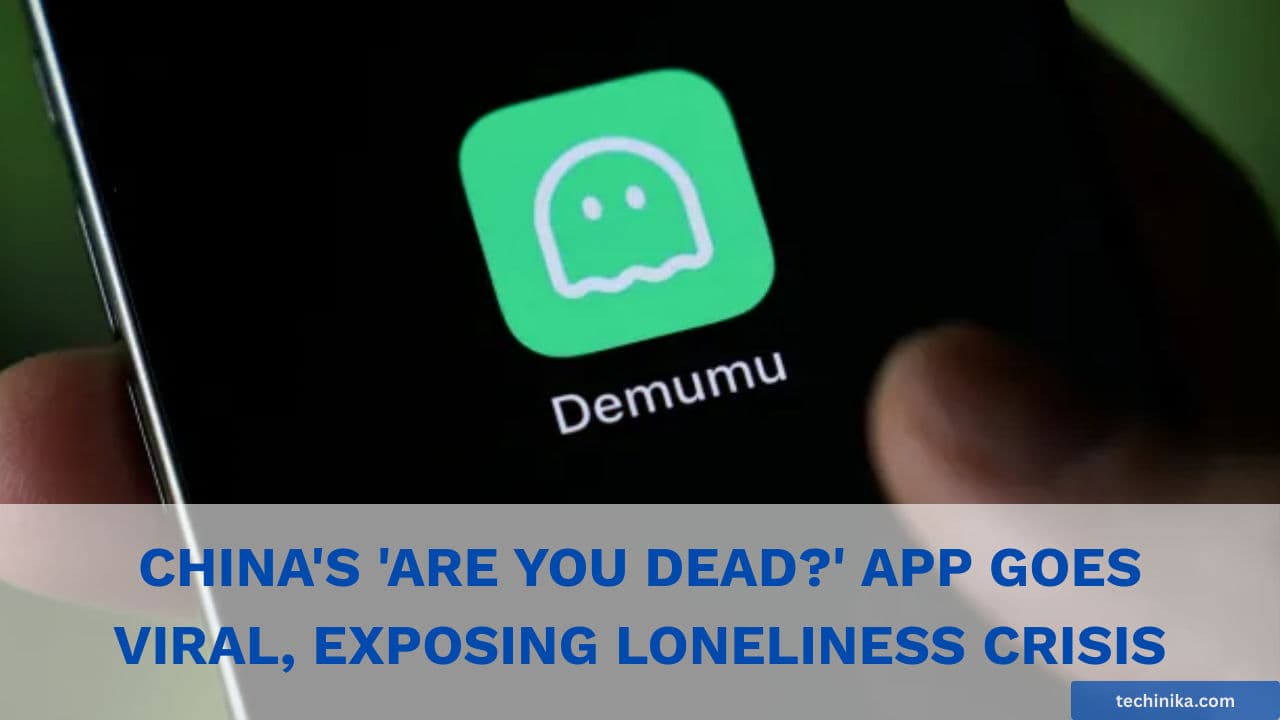
Developed by a small team at Yuejing Technical Services Company in Henan Province, the app features minimalist design; a white ghost icon on green background with a single oversized check-in button. Users enter their name and one emergency contact email address. The system then sends alerts via email and SMS if check-ins lapse, functioning as a digital version of medical alert pendants marketed to elderly Americans with the famous "I've fallen and can't get up" tagline.
Originally launched in June 2025 at just 1 yuan (14 cents), the app remained obscure until viral social media posts drove downloads up 100-fold within days this January. Facing surging server costs, developers raised the price to 8 yuan ($1.15) and announced plans to add SMS notification features and explore more senior-friendly products. The international version, hastily rebranded as "Demumu," remains available in Hong Kong and other markets outside mainland China.
Tapping Into National Loneliness
The app's explosive popularity reveals uncomfortable truths about China's demographic transformation. Real estate research institutions project China may have up to 200 million one-person households by 2030, with solo living rates exceeding 30 percent. This population spans elderly individuals aging alone and young professionals migrating to cities for work, often laboring under grueling hours with minimal social connections.
Social media responses captured the emotional resonance. "For the first time, someone is concerned about whether I'm dead or alive," one Weibo user wrote. Another commented that the 8-yuan app represented "the last bit of dignity for so many young people living alone. The scariest thing isn't loneliness, it's disappearing." A business commentary on Yicai noted the app serves as "a darkly humorous social metaphor, reminding us to pay attention to the living conditions and inner world of contemporary young people."
The Name Debate
Death remains deeply taboo in Chinese culture, where buildings routinely omit fourth floors because the word for "four" sounds like "death" in Mandarin. The app's blunt name sparked controversy alongside admiration. Former Global Times editor Hu Xijin praised its potential for elderly users but suggested renaming it "Are You Alive?" for psychological comfort. The developers initially announced a rebrand to "Demumu", where "de" derives from the English word "death" while "mumu" adds a friendlier feel before reversing course after user backlash and offering rewards for better naming suggestions.
Many users defended the original directness. "Maybe some conservative people can't accept it," one wrote, "but it will make us unmarried people feel more at ease to spend our lives." The debate reflects tension between cultural sensitivities around mortality and pragmatic acknowledgment of risks facing isolated individuals.
What This Reveals About Modern Society
The app's virality offers several insights extending beyond China.
- First, it demonstrates how simple technology addressing fundamental safety needs can resonate powerfully when existing social structures fail to adequately support vulnerable populations.The developer told media that after creating entertainment apps, they wanted something meeting deeper needs in Maslow's hierarchy; specifically safety requirements affecting broad populations.
- Second, the overwhelming response exposes gaps in social safety nets as family structures fragment and urbanization accelerates. Stuart Gietel-Basten, a professor at Hong Kong University of Science and Technology, noted the app "taps into this feeling of atomization, being stuck on your own, being isolated in terms of very long working hours." When millions feel invisible in their daily lives, a $1 app asking "are you dead?" becomes meaningful affirmation that someone, somewhere, would notice their absence.
- Third, the phenomenon highlights how digital solutions emerge to address problems that traditional community structures once solved organically. Neighbors checking on elderly residents, families living in multi-generational households, workplace colleagues noticing absences, these informal safety nets have weakened as societies modernize and individualize. Technology fills the void, but the fact that millions feel they need an app to ensure someone discovers if they die alone speaks to profound social disconnection.
The app's removal from mainland Chinese stores following international media coverage suggests authorities may view its popularity as embarrassing commentary on social conditions. Yet the underlying problem of hundreds of millions living in isolation with limited support systems persists regardless of app availability. Whether rebranded as "Demumu," renamed through crowdsourcing, or replaced by competitors, the demand for such services will likely continue growing alongside solo living rates. The viral success of an app with such grim functionality serves less as a technology story than as a mirror reflecting anxieties about modern life's increasing atomization.
If you enjoyed this article, follow us on WhatsApp for daily tech updates. If you have an idea, need to be featured or need to partner, reach out to us at editorial@techinika.com or use our contact page.
Don't let the story end here.
Share your thoughts, ask questions, and connect with the community.

Cishahayo Songa Achille
Chief EditorCishahayo Songa Achille is a Rwandan software engineer and tech entrepreneur focused on democratizing digital skills. He is best known as the Founder and Managing Director of Techinika, an edtech firm established in 2020 to make complex technological advances accessible to the general public and build solutions for the biggest problems.
View all articles by Cishahayo Songa Achille →