China Successfully Launches Communications Technology Test Satellite-20 on Long March 5
AI Quick Summary
- China successfully launched the Communications Technology Test Satellite-20 (TJS-20) on October 23, 2025, using a Long March-5 rocket from the Wenchang Space Launch Site.
- The TJS-20 satellite is primarily tasked with validating multi-band and high-speed communication technologies in space.
- The Long March-5 carrier rocket utilized an extended fairing, making its configuration for this mission the tallest in China's space program at 63.2 meters.
- This mission marked China's 66th space launch of 2025, indicating an accelerated pace in its national space activities.
- The launch supports China's strategic goals of developing a comprehensive space industrial ecosystem in Hainan and establishing a robust Low Earth Orbit (LEO) satellite constellation.
Following the TJS-20 launch, China successfully sent the Shenzhou-21 crew to its space station on October 31, 2025, although the Shenzhou-20 crew's return was notably delayed due to a suspected space debris impact.
China successfully launched the Communications Technology Test Satellite-20 (Tongxin Jishu Shiyan-20, or TJS-20) on October 23, 2025, at 10:30 PM Beijing Time from the Wenchang Space Launch Site in Hainan Province. According to Xinhua News Agency, the satellite entered its planned orbit successfully aboard a Long March-5 carrier rocket.
Launch Specifications and Mission
China Daily reports that the satellite will be used mainly to carry out multi-band and high-speed communication technology validation tests. The mission marks the 602nd flight of the Long March carrier rocket series, demonstrating the maturity and reliability of China's space launch capabilities.
People's Daily Online confirms that the Communications Technology Demonstrator 20 was built by China Academy of Space Technology, a subsidiary of China Aerospace Science and Technology Corp (CASC), the nation's dominant space contractor. The satellite is tasked with verifying multi-band high-speed satellite communications technologies.
Long March 5: China's Tallest Rocket
According to CASC's news release, the Long March 5 configuration used for this launch featured an extended fairing—the top structure containing the satellite—measuring 18.5 meters tall. This compares to typical Long March 5 fairings of approximately 12.3 meters.
The Long March 5 is currently China's most powerful rocket, capable of delivering significant payloads to various orbits, establishing it as the backbone of the country's most ambitious space missions.
Wenchang Space Launch Center
The launch took place at Wenchang Space Launch Site, located on China's southernmost island province of Hainan. CGTN reports that the coastal spaceport provides strategic advantages for launching heavy payloads due to its proximity to the equator and access to ocean recovery zones.
China Daily's earlier analysis notes that Launch Pads 1 and 2 at the Wenchang launch site will have a combined annual launch capacity of 32 liquid-propellant rocket missions, marking a significant improvement over traditional launch facilities.
2025: A Record Year for Chinese Space Launches
The TJS-20 launch represents China's 66th space launch of 2025, according to mission tracking. This puts the country on track to potentially exceed its national record of 68 orbital launches set in 2024, demonstrating the accelerating pace of China's space activities.
Upcoming Shenzhou-21 Crewed Mission
CGTN reports that preparations are underway for the launch of the Shenzhou-21 crewed spaceship, China's next manned mission to the Tiangong space station. The crewed mission is expected to launch from Jiuquan Satellite Launch Center around October 30, 2025.
The Shenzhou-21 mission will continue China's program of maintaining a continuous human presence aboard Tiangong, the country's modular space station that has been operational since 2022. This represents another milestone in China's comprehensive space exploration strategy, which combines crewed missions, satellite deployments, and deep space exploration.
Multi-Band High-Speed Communication Technology
Global Times emphasizes that the TJS-20 satellite will conduct validation tests for multi-band and high-speed communication technology. While specific technical parameters have not been publicly disclosed, these tests are crucial for advancing China's satellite communication capabilities.
Multi-band communication allows satellites to operate across different frequency ranges, providing flexibility and redundancy. High-speed communication technology is essential for meeting growing bandwidth demands from both civilian and specialized applications.
China's Satellite Communication Ambitions
China Daily's recent analysis reveals that China established China Satellite Network Group Co Ltd in 2021, an initiative focused on building a Low Earth Orbit (LEO) satellite constellation. Companies like China Satellite Network Group Co Ltd and Spacesail are driving this ambitious project forward.
Local governments are also mobilizing rapidly. Hainan province is intensifying efforts to build a comprehensive aerospace industrial cluster at Wenchang international aerospace city, focusing on satellite launches, satellite manufacturing, and data chain development, with an ambitious goal to generate 10 billion yuan in revenue from the facility by 2027.
Growing Satellite Manufacturing Capacity
According to Orient Securities analysis, several major private aerospace companies currently have an average annual satellite production capacity of about 300 units, which is expected to expand to 500-600 units in the near future.
Minsheng Securities notes that 2025 and 2026 will be critical years for the debut and validation of new-generation reusable rockets, both from private and State-owned enterprises, potentially marking a true turning point for commercial rocket development in China.
Global Satellite Communication Landscape
China Daily's analysis provides context for China's satellite efforts within the global landscape. In the United States, SpaceX has launched over 9,100 Starlink satellites, with approximately 8,200-8,300 satellites actively in orbit. By March 2025, Starlink had surpassed 6 million users across more than 120 countries and regions.
The UK's OneWeb has deployed 648 LEO satellites, establishing the world's second-largest LEO constellation. Canada's Telesat is developing the Lightspeed constellation, comprising 198 satellites. China, though described as a late entrant, is rapidly catching up through coordinated government and commercial initiatives.
Hainan's Aerospace Development Strategy
In August 2025, the Hainan provincial government issued a three-year plan (2025-27) to develop a modern industrial system with local characteristics and advantages. The province aims to establish itself as a comprehensive aerospace hub combining launch capabilities, manufacturing, and data services.
Once the satellite super factory becomes operational, the facility is expected to provide significant momentum for Hainan's space sector and national space internet infrastructure development, according to industry experts quoted by China Daily.
TJS Satellite Series Background
The TJS-20 satellite is part of China's Communications Technology Experimental Satellite series. While CASC provides limited public information about individual TJS missions, stating they are used for communication technology validation tests, the series has been launched regularly since 2015.
Previous TJS satellites have tested various communication technologies and operational concepts. The continuity of the program demonstrates China's methodical approach to developing and validating space-based communication capabilities through incremental technological advancement.
Successful Orbit Insertion
Guangming Online confirms that the satellite successfully entered its planned orbit following separation from the Long March 5 rocket. CASC announced launch success approximately one hour after liftoff, following standard procedures for tracking and confirming orbital parameters.
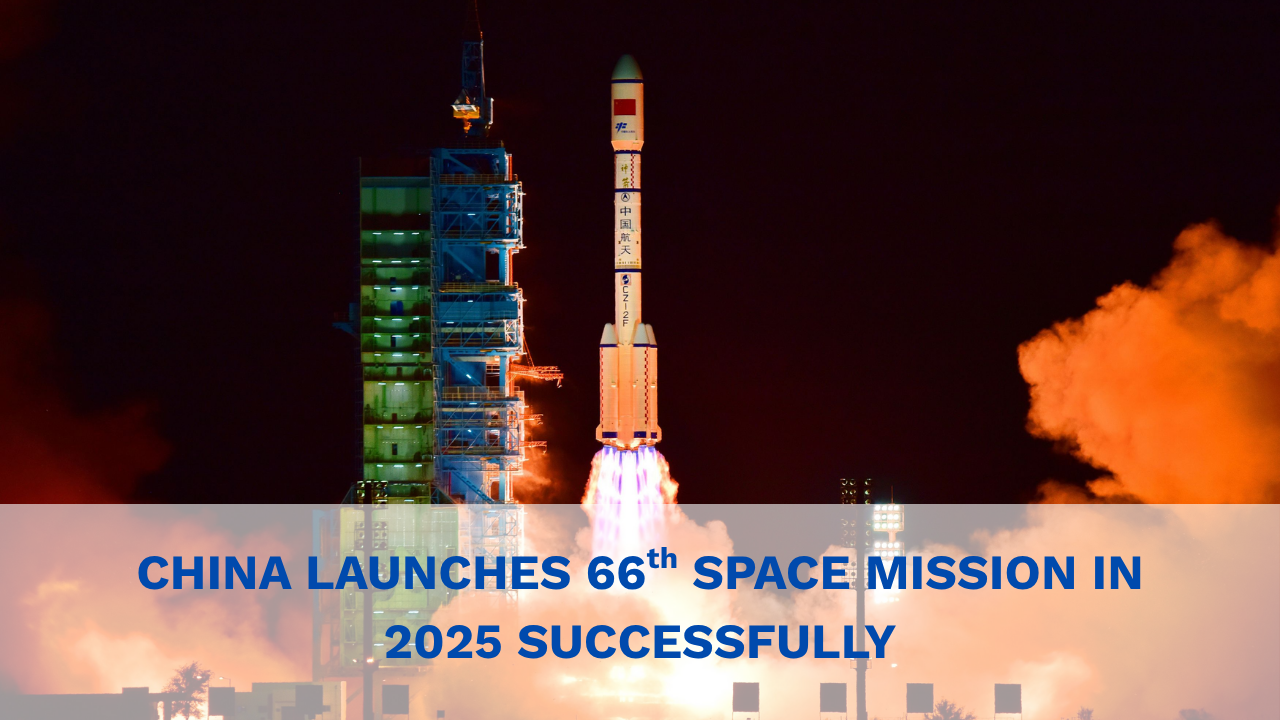
Photographs released by Xinhua News Agency show the Long March 5 rocket blasting off from the coastal service tower at Wenchang, piercing through a layer of clouds as it climbed into the night sky above Hainan Province.
Strategic Significance
The successful launch of TJS-20 demonstrates several strategic priorities for China's space program:
Technology Validation: Testing advanced communication technologies in actual space conditions provides critical data for future operational systems.
Launch Capability: The 602nd Long March mission and China's 66th launch of 2025 showcase reliable, high-frequency launch capabilities.
Industrial Development: The mission supports broader goals of developing a comprehensive space industrial ecosystem centered in Hainan.
Cadence Maintenance: Regular launches maintain operational readiness and technical proficiency across China's space enterprise.
What Comes Next
With the TJS-20 launch completed successfully, attention now turns to the upcoming Shenzhou-21 crewed mission scheduled for around October 30, 2025. The frequency of launches from Wenchang and other Chinese spaceports demonstrates the country's commitment to maintaining an active presence in space across multiple mission types.
Beijing Review notes that China's space program continues advancing on multiple fronts simultaneously—crewed missions, satellite constellations, lunar exploration, and Mars missions—reflecting comprehensive strategic planning for space activities.
The successful completion of the TJS-20 mission adds another achievement to China's growing portfolio of space capabilities, contributing to the nation's goal of becoming a comprehensive space power by 2030.
Information for this article was sourced from Xinhua News Agency, China Daily, People's Daily Online, CGTN, Global Times, Guangming Online, and Beijing Review. For official updates on China's space program, visit China National Space Administration.
If you enjoyed this article, follow us on WhatsApp for daily tech updates. If you have an idea, need to be featured or need to partner, reach out to us at editorial@techinika.com or use our contact page.
Don't let the story end here.
Share your thoughts, ask questions, and connect with the community.

Cishahayo Songa Achille
Chief EditorCishahayo Songa Achille is a Rwandan software engineer and tech entrepreneur focused on democratizing digital skills. He is best known as the Founder and Managing Director of Techinika, an edtech firm established in 2020 to make complex technological advances accessible to the general public and build solutions for the biggest problems.
View all articles by Cishahayo Songa Achille →