WeRide Makes History with Dual Hong Kong-US Listing, But Shares Stumble on Debut
AI Quick Summary
- WeRide became the first autonomous driving company to achieve dual primary listings on both the Hong Kong Stock Exchange and Nasdaq.
- The company's Hong Kong debut saw shares drop significantly, highlighting investor skepticism about profitability in the competitive autonomous vehicle sector.
- WeRide's dual listing is a strategic move for Chinese tech companies to mitigate geopolitical risks and gain access to diverse capital markets.
- The company operates a substantial fleet of Level 4 autonomous vehicles globally and offers a range of products beyond robotaxis, including logistics and sanitation solutions.
- Despite market concerns and intense competition, WeRide's CEO demonstrated long-term commitment with a three-year share lock-up.
Since the article, WeRide expanded its robotaxi services in the Middle East with Uber, though it temporarily suspended its Dubai fleet in March 2026 due to regional conflict, and its stock is trading near 52-week lows.
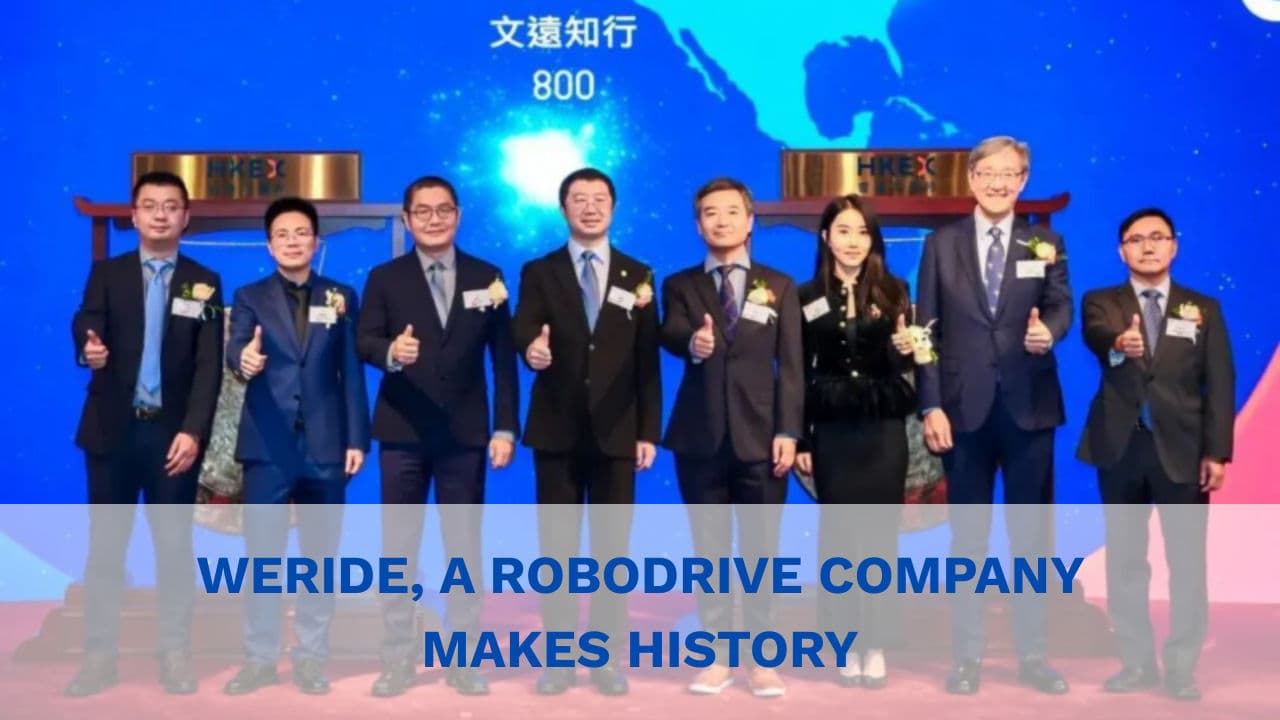
Chinese robotaxi pioneer WeRide achieved a historic milestone on November 6, becoming the world's first autonomous driving company to secure dual primary listings on both the Hong Kong Stock Exchange and Nasdaq. Yet the celebration was tempered by a rocky market debut that saw shares slip as much as 15%, highlighting growing investor concerns about profitability in the increasingly crowded autonomous vehicle sector.
WeRide listed on the Hong Kong Stock Exchange under ticker 0800.HK, issuing 88.25 million shares at HK$27.1 per share and raising approximately HK$2.39 billion ($308 million). The offering consisted of 17.65 million shares for public subscription and 70.60 million shares allocated for international institutional investors. The listing price represented a nearly 4% discount to WeRide's Monday close of $10.90 on Nasdaq, where the company first went public on October 25, 2024.
WeRide operates over 1,500 Level 4 autonomous vehicles, including more than 700 robotaxis, across 30 cities in 11 countries. The company holds autonomous driving permits in seven markets—China, UAE, Singapore, France, Saudi Arabia, Belgium, and the US—and plans to scale to tens of thousands of robotaxis by 2030.
The dual listing strategy reflects a broader trend among Chinese technology companies seeking to hedge against geopolitical risks. WeRide and rival Pony.ai, both backed by ride-hailing giant Uber, pursued Hong Kong listings amid concerns that the Trump administration might move to delist Chinese companies from US exchanges. Pony.ai raised HK$6.7 billion ($862 million) in its concurrent Hong Kong offering, making the robotaxi firms the latest in a wave of Chinese tech companies securing capital closer to home.
At the listing ceremony, WeRide Founder and CEO Dr. Tony Han emphasized the company's evolution "from technological innovation to commercial operation" over the past eight years. The Guangzhou-based company, founded in 2017, has built an impressive commercial footprint. Its WeRide One platform powers a diverse product lineup spanning Robotaxis, Robobuses, Robovans, Robosweepers, and advanced driver-assistance systems (ADAS), addressing transportation needs across mobility, logistics, and sanitation sectors.
Market Skepticism Clouds Launch
Despite WeRide's technological achievements and global reach, both WeRide and Pony.ai fell as much as 15% on their Hong Kong debut as analysts raised concerns about profitability in an increasingly competitive sector. The lukewarm reception contrasts sharply with battery maker CATL's Hong Kong listing, which surged 16% on its first trading day.
The market's hesitation reflects fundamental questions about the autonomous vehicle business model. While WeRide has secured partnerships with industry heavyweights including NVIDIA, Bosch, Uber, Grab, and the Renault-Nissan alliance, the path to profitability remains uncertain. Hong Kong has benefited from a dealmaking boom as mainland businesses seek capital in the city, but robotaxi startups struggled to gain altitude, driven by concerns over profitability and an increasing number of entrants in the sector.
The competitive landscape has intensified dramatically. Tesla's Full Self-Driving technology continues advancing, traditional automakers are investing billions in autonomous systems, and Chinese competitors like Baidu's Apollo Go are aggressively expanding. Meanwhile, regulatory hurdles vary widely across markets, complicating global deployment strategies.
CEO's Three-Year Lock-Up Signals Confidence
In a move designed to reassure investors of management's long-term commitment, Dr. Tony Han voluntarily committed to a three-year lock-up period on October 28, pledging not to sell any of his shares for the next three years. This extended restriction goes beyond typical IPO lock-up periods and demonstrates the founder's conviction in WeRide's growth trajectory despite near-term market skepticism.
WeRide has earned recognition on Fortune's Change the World list twice—the only autonomous driving company to achieve this distinction—and appeared twice on Fortune's Global Future 50, ranking 16th this year, the highest among Chinese companies. These accolades underscore the company's technological leadership even as investors question its financial prospects.
Product Momentum and Strategic Partnerships
WeRide's Hong Kong listing comes as the company reaches critical commercialization milestones. In the ADAS sector, WeRide and Bosch's jointly developed one-stage end-to-end assisted driving solution has achieved start of production (SOP) and is set to enter mass production in 2025. This represents WeRide's first foray into the lucrative automotive supplier market, where margins are more predictable than robotaxi operations.
The company's WeRide GENESIS simulation engine has proven instrumental in accelerating development while reducing costs. By creating a closed-loop testing environment, WeRide has lowered road testing expenses and safety risks while speeding product iteration. This technological infrastructure positions the company to scale operations more efficiently than competitors relying primarily on real-world testing.
The HKEX listing broadens WeRide's investor base and access to capital markets, enabling deeper investment in technology R&D and accelerating the global deployment of its autonomous vehicle fleet. With operations spanning Asia, the Middle East, Europe, and North America, WeRide's dual listing provides currency flexibility and reduces reliance on US capital markets—a strategic advantage as geopolitical tensions persist.
The Road Ahead
WeRide's stumbling debut doesn't necessarily predict long-term failure. Many groundbreaking technology companies faced initial market skepticism before demonstrating sustainable business models. Amazon, Tesla, and even Alibaba experienced volatility in their early public market years before investor sentiment shifted.
The key questions facing WeRide and the broader autonomous vehicle sector remain unchanged: When will regulatory frameworks allow widespread driverless operations? Can robotaxi economics achieve profitability at scale? And will consumers embrace autonomous transportation quickly enough to justify current valuations?
For now, WeRide has secured substantial capital to pursue its vision of transforming urban mobility. The company's dual listing strategy provides geographic diversification, access to both Western and Asian investors, and a hedge against regulatory risks in any single market. Whether that proves sufficient to overcome profitability concerns and competitive pressures will determine if WeRide's historic listing marks the beginning of sustained success or simply an ambitious bet on a future that takes longer to materialize than optimists expect.
As the autonomous vehicle race accelerates, WeRide's public market performance will serve as a barometer for investor confidence in the sector's near-term commercial viability.
If you enjoyed this article, follow us on WhatsApp for daily tech updates. If you have an idea, need to be featured or need to partner, reach out to us at editorial@techinika.com or use our contact page.
Don't let the story end here.
Share your thoughts, ask questions, and connect with the community.

Cishahayo Songa Achille
Chief EditorCishahayo Songa Achille is a Rwandan software engineer and tech entrepreneur focused on democratizing digital skills. He is best known as the Founder and Managing Director of Techinika, an edtech firm established in 2020 to make complex technological advances accessible to the general public and build solutions for the biggest problems.
View all articles by Cishahayo Songa Achille →Up Next
Hanga Pitchfest Announces Top 45 Startups for 2026 EditionBy Cishahayo Songa Achille • 5 min read