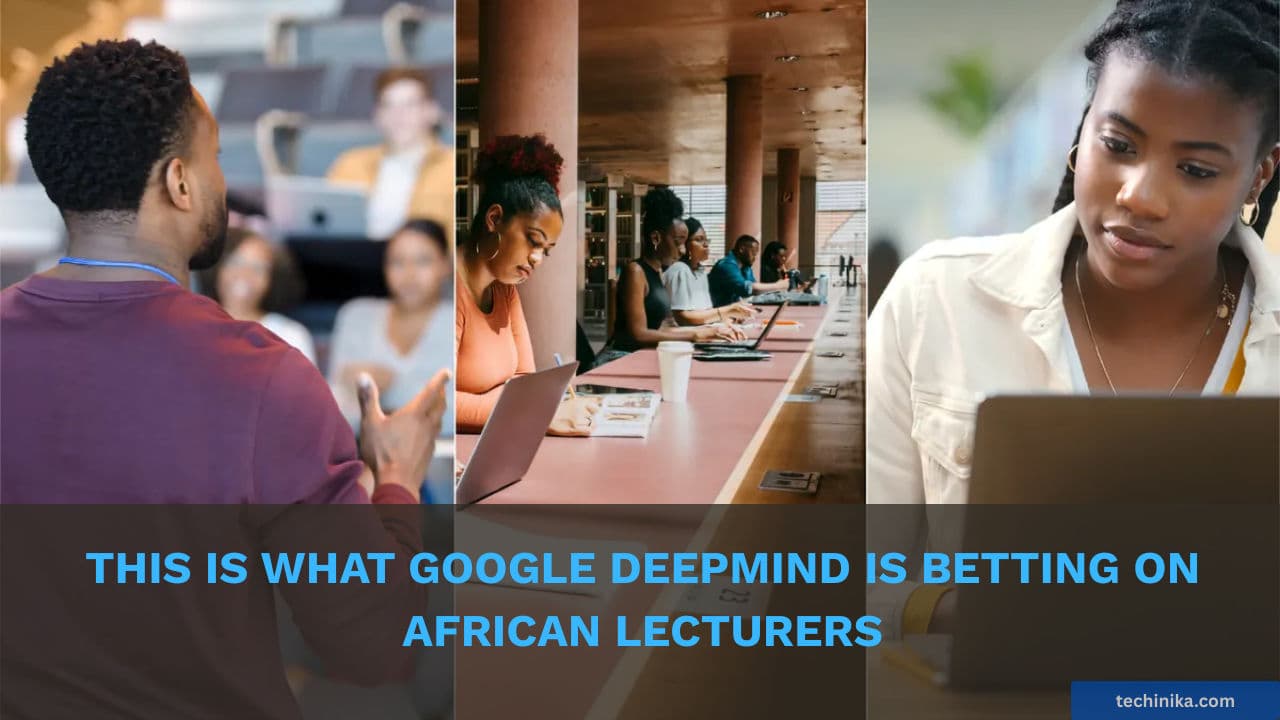
This is What Google DeepMind is Betting on African Lecturers
AI Quick Summary
- Google DeepMind launched the AI Research Foundations curriculum for Africa on March 17, 2026, in collaboration with Google.org and Data Science Africa (DSA).
- This $4 million "train-the-trainer" initiative aims to develop "AI Champions" among university lecturers at 15 partner universities in six African countries.
- The program provides an 8-course roadmap offering direct access to advanced AI models like Gemini and Gemma, multimodal embedding tools, and GPU cloud infrastructure.
- It also includes Python labs, Transformer blueprints, and tools for localizing low-resource language datasets to prevent AI hallucinations.
- The goal is to transition Africa from an AI consumer to an AI architect, enabling local development of AI solutions for regional challenges.
The AI Research Foundations curriculum has just been launched across Africa, focusing on empowering educators and researchers in the continent.
On March 17, 2026, Google DeepMind officially launched the AI Research Foundations curriculum; a high-level academic program specifically localized for the African continent. In a coordinated announcement with Google.org and Data Science Africa (DSA), the lab unveiled a $4 million initiative to bridge the global research gap.
This investment is a "train-the-trainer" mission designed to equip university lecturers; the continent’s "AI Champions" at 15 partner universities in Rwanda, Uganda, Kenya, Nigeria, South Africa, and Ghana.
What is Google DeepMind?
Google DeepMind is the premier artificial intelligence research laboratory of Alphabet Inc., established in April 2023 through the strategic merger of Google Brain and DeepMind Technologies. Originally founded in London in 2010, the organization was built on a singular mission: to "solve intelligence" and benefit humanity.
While headquartered in London, DeepMind opened its first continental research hub in Accra, Ghana, in 2019. Rather than focusing solely on commercial products, DeepMind’s legacy is built on scientific breakthroughs. Their achievements include AlphaFold, which solved a 50-year challenge in biology, and WeatherNext 2, a forecasting model currently providing hyper-local weather data to help West African farmers combat climate instability.
The Google DeepMind Tech Stack
This initiative is delivered through a specialized 8-course roadmap designed to move researchers from using basic APIs to architecting proprietary systems. This high-performance "sandbox" provides:
- The Model Core (Gemini & Gemma): Direct architectural access to Gemini 3.1 and the open-weights Gemma 3 family to study "Deep Think" reasoning and GPU optimization.
- Multimodal Embedding 2: Training on Google’s newest model that maps text, images, and audio into a single space; essential for building apps that understand visual contexts.
- The "Compute" Bridge: Provision of GPU credits and cloud infrastructure to remove the "hardware wall" for students in regional hubs.
- Python Labs & Transformer Blueprints: Access to the actual source code to re-engineer attention mechanisms for low-bandwidth environments.
- Dataset Localization Tools: A Tokenization toolkit designed to help developers clean and structure "low-resource" language data (like Kinyarwanda or Luganda) so that local AI doesn't hallucinate or fail.
From Consumer to Architect
By providing the technical infrastructure, the code, and the academic structure, Google DeepMind is moving Africa from an AI consumer to a primary architect. This 8-course roadmap facilitates the transition by guiding researchers from the fundamentals of building Small Language Models (SLMs) and localizing language data to the deep mechanics of neural network design and the Transformer architecture.
By mastering fine-tuning, model alignment, and hardware acceleration, students will culminate their journey with a capstone project; building functional AI solutions for real-world regional challenges. The goal is clear: ensuring the next major breakthrough in artificial intelligence is born within an African lab.
Resources:
If you enjoyed this article, follow us on WhatsApp for daily tech updates. If you have an idea, need to be featured or need to partner, reach out to us at editorial@techinika.com or use our contact page.
Don't let the story end here.
Share your thoughts, ask questions, and connect with the community.

Kellycie Bayingana
AuthorPassionate about the intersection of technology and storytelling. I am committed to uncovering and sharing the most compelling startup narratives from across Rwanda for Techinika.
View all articles by Kellycie Bayingana →