Historic UN Cybercrime Convention: 72 Nations Sign First Global Treaty Against Digital Crime
AI Quick Summary
- Seventy-two nations signed the landmark UN Convention against Cybercrime in Hanoi on October 25, 2025, creating the first universal framework to combat digital offenses globally.
- The Convention establishes common international standards for investigating and prosecuting cybercrimes, including unified definitions, victim assistance, and mechanisms for sharing electronic evidence across borders.
- It addresses the escalating global cost of cybercrime, projected at $10.5 trillion annually by 2025, and provides crucial training and technical assistance, especially for developing nations.
- The treaty aims to enhance cooperation between law enforcement agencies and harmonize the criminalization of cyber-related offenses worldwide.
- Despite criticism regarding vague definitions and potential human rights concerns, the Convention emphasizes balancing security with the safeguarding of privacy and fundamental rights.
After its signing, the number of signatories slightly increased to 74, and the Convention is expected to enter into force in early 2026, 90 days after receiving 40 ratifications.
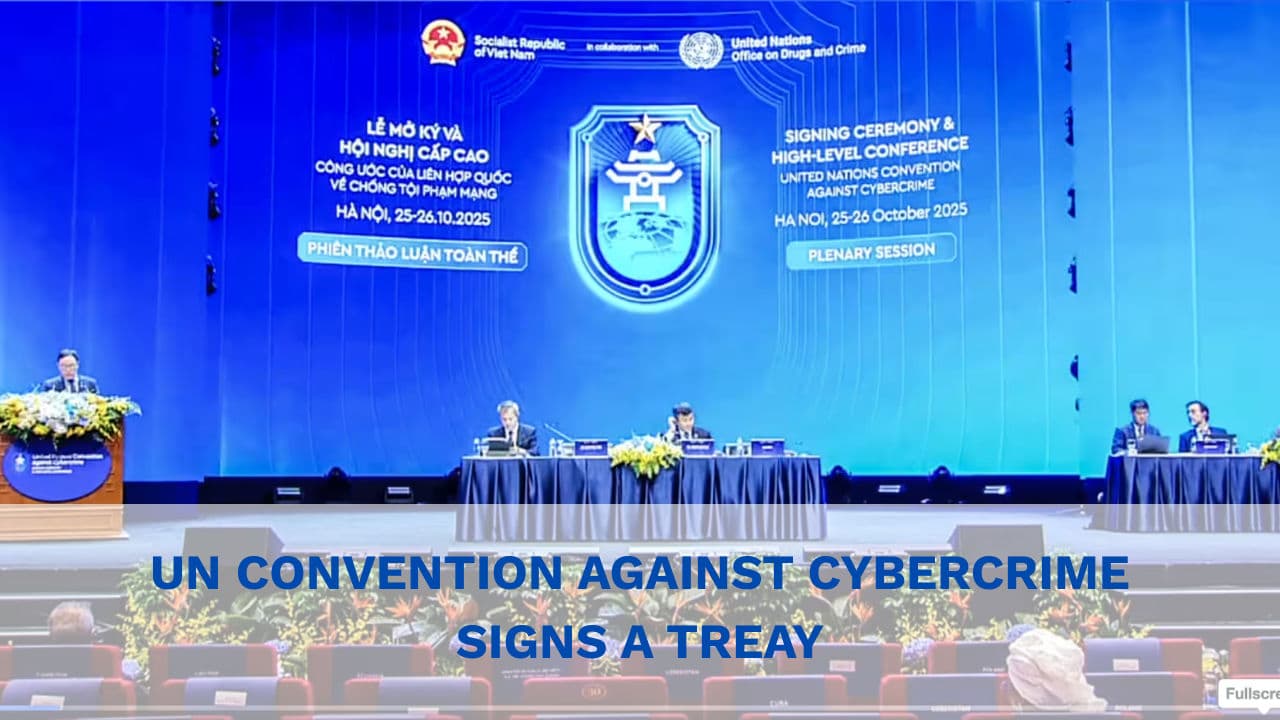
Seventy-two nations signed a landmark United Nations treaty in Hanoi on October 25, 2025, establishing the first universal framework for combating cybercrime. UN Secretary-General António Guterres hailed the Convention against Cybercrime as "a historic step toward a safer digital world," marking the first international criminal justice treaty in more than two decades.
The Hanoi Signing Ceremony
The UN Office on Drugs and Crime (UNODC) confirmed that 72 states signed the Convention during the two-day ceremony hosted by Vietnam in collaboration with UNODC. The initial count of 65 signatories on the first day grew to 72, including Western democracies like Czech Republic and Australia, demonstrating broad international support.
"The UN Cybercrime Convention is a powerful, legally binding instrument to strengthen our collective defences against cybercrime," Guterres stated at the ceremony. "It is a testament to the continued power of multilateralism to deliver solutions. And it is a vow that no country, no matter their level of development, will be left defenceless against cybercrime."
Five Years of Negotiations
Adopted by the UN General Assembly in December 2024 after five years of negotiations, the Convention establishes common international frameworks for investigating and prosecuting online offences—from ransomware and financial fraud to non-consensual sharing of intimate images.
What the Convention Addresses
The Convention introduces unified definitions, investigation standards, and mechanisms for assisting victims—including compensation, restitution, and removal of illegal content. According to UN News, while some countries still lack clear legal definitions of cybercrime and mechanisms for international cooperation, cybercrime itself rapidly evolves, making this framework increasingly urgent.
The EU Council noted that key aspects include harmonizing criminalization of cyber-related offences across participating countries, ensuring all nations commit to making certain conduct—such as hacking, identity theft, and online fraud—criminal offenses with comparable penalties.
The $10.5 Trillion Problem
The Convention addresses a growing crisis. Global cybercrime costs are projected to reach $10.5 trillion annually by 2025, according to industry experts cited by UN News. Secretary-General Guterres warned that "every day, sophisticated scams defraud families, steal livelihoods and drain billions of dollars from our economies."
"In cyberspace, nobody is safe until everybody is safe," Guterres emphasized. "One vulnerability anywhere can expose people and institutions everywhere."
Critical for Developing Nations
For many governments, particularly in the Global South, the treaty represents an opportunity to access training, technical assistance, and real-time cooperation channels. UNODC Executive Director Ghada Waly emphasized that "cybercrime is changing the face of organized crime as we know it, and the new UN Cybercrime Convention provides Member States with a vital tool to fight back together."
Waly noted that UNODC has already developed a ratification methodology accounting for different legal systems and capabilities, and will provide tailored technical assistance on implementation. The Office's years of experience supporting over 60 countries to respond to cybercrime gives it a strong foundation for helping implement the new Convention.
What Happens Next
The Convention remains open for signature at UN Headquarters in New York until December 31, 2026. Following signature, states will go through internal domestic processes to ratify the treaty, formally becoming States Parties through ratification, accession, acceptance, or approval.
The treaty will enter into force 90 days after being ratified by the 40th signatory. UNODC will continue serving as secretariat to the Ad Hoc Committee, mandated to negotiate a draft protocol supplementing the Convention and to the future Conference of States Parties.
"Now we must turn signatures into action," Guterres urged. "The Convention must be ratified quickly, implemented fully, and supported with funding, training and technology—especially for developing countries."
Balancing Security and Rights
The Convention has faced criticism from NGOs, academics, technology companies, and policy experts concerned about expanding surveillance and data collection capacities without adequate human rights safeguards. Critics focus on vague definitions of cybercrime and implementation being left to individual countries, including those with human rights abuse records.
The Convention discusses respecting international human rights law but relies on existing instruments like the International Covenant on Civil and Political Rights rather than establishing new standards specific to cybercrime. Implementation of human rights safeguards is left to individual countries to legislate.
Despite these concerns, Guterres emphasized that the Convention represents "a victory for victims of online abuse" and "a clear pathway for investigators and prosecutors" to overcome barriers when crimes and evidence cross multiple borders. The treaty aims to improve cooperation between law enforcement while safeguarding privacy, dignity, and fundamental rights.
Origins and Geopolitical Context
The UN cybercrime convention was first proposed in 2017 by Russia, which had long objected to the existing Budapest Convention established by the Council of Europe in 2004. Russia viewed the Budapest Convention as a threat to internet sovereignty and control.
Though initially opposed to the convention, the United States remained involved in treaty development to avoid it being shaped solely by adversaries. The final text represents compromise between various international interests, balancing security cooperation with sovereignty concerns.
Practical Implications
The Convention establishes a global standard for electronic evidence, aiming to improve cooperation between law enforcement agencies across borders. For investigators and prosecutors, this means clearer procedures for requesting and sharing digital evidence when crimes span multiple jurisdictions.
States will implement measures in accordance with national legislation but within agreed international principles. As UN News explained, "perhaps, with this Convention, a new era will begin—one in which a single wrong letter in a website address will no longer cost you everything," referring to common phishing scams that exploit typos to steal credentials and funds.
European Union's Participation
The EU Council adopted a decision on October 7, 2025, authorizing the European Commission and member states to sign the Convention. According to a 2024 Europol threat assessment, cybercrime has dramatically increased in volume, intensity, and harm potential, while electronic evidence has grown increasingly important in criminal investigations.
The EU presidency will prioritize finalizing the corresponding Council decision for the EU and member states to conclude the Convention, seeking European Parliament consent for ratification.
UNODC's Continuing Role
Beyond serving as secretariat, UNODC's Global Programme on Cybercrime provides technical assistance and training to states to build capacity of national authorities to prevent, detect, investigate, and prosecute cybercrime. This support will be crucial for implementing Convention provisions, particularly in developing countries.
Vietnam's Hosting Role
The signing ceremony in Hanoi highlights Vietnam's active contribution to digital governance. Vietnamese President Luong Cuong issued a statement marking the occasion, emphasizing the country's commitment to international cooperation on cybersecurity.
The choice of Hanoi as host city follows precedent for UN criminal justice treaties, bringing attention to the new treaty and encouraging high-level official participation.
Secretary-General's Vision
In his remarks, Guterres warned that while technology has brought "extraordinary progress," it has also created new vulnerabilities. He emphasized the Convention represents more than security cooperation—it's about building a digital future that respects everyone's dignity and rights.
"Let us seize this moment," Guterres said. "Let us build a cyberspace that respects everyone's dignity and human rights—and ensure that the digital age delivers peace, security and prosperity for all."
Why This Matters
The Convention marks the first international criminal justice treaty in over 20 years, addressing crimes that didn't exist when previous frameworks were established. As ransomware attacks cripple hospitals, financial fraud drains billions, and online exploitation destroys lives, the treaty provides legal infrastructure for coordinated response.
For countries lacking robust cybercrime laws or investigative capabilities, the Convention offers a roadmap. For nations with advanced systems, it provides mechanisms for cross-border cooperation that have been sorely lacking.
Whether the Convention succeeds will depend on ratification speed, implementation quality, and whether human rights concerns can be adequately addressed. But its signing represents recognition that cyber threats require global solutions—and that multilateral cooperation remains possible even in a fractured geopolitical environment.
The United Nations Convention against Cybercrime will remain open for signature at UN Headquarters in New York until December 31, 2026. For more information, visit UNODC's Convention webpage.
If you enjoyed this article, follow us on WhatsApp for daily tech updates. If you have an idea, need to be featured or need to partner, reach out to us at editorial@techinika.com or use our contact page.
Don't let the story end here.
Share your thoughts, ask questions, and connect with the community.

Cishahayo Songa Achille
Chief EditorCishahayo Songa Achille is a Rwandan software engineer and tech entrepreneur focused on democratizing digital skills. He is best known as the Founder and Managing Director of Techinika, an edtech firm established in 2020 to make complex technological advances accessible to the general public and build solutions for the biggest problems.
View all articles by Cishahayo Songa Achille →Up Next
Rwanda and Kenya Sign Kigali Declaration to Allow Fintechs Operate Across BordersBy Mwiza Zamda • 2 min read