Google Achieves Quantum Computing Breakthrough: 13,000x Faster Than Supercomputers
AI Quick Summary
- Google announced a breakthrough with its "Quantum Echoes" algorithm on the 105-qubit Willow chip, performing calculations 13,000 times faster than supercomputers.
- This is the first "verifiable quantum advantage," meaning the results can be independently repeated and confirmed by other quantum computers.
- The algorithm works by sending a signal into the quantum system, disturbing it, and then reversing the signal to listen for amplified quantum "echoes" that reveal molecular information.
- Unlike previous abstract demonstrations, Quantum Echoes has clear practical applications in drug discovery (analyzing molecular interactions) and materials science (designing better batteries and advanced materials).
- While practical applications are still years away, requiring significantly larger quantum computers, this breakthrough marks a critical step toward useful, fast, and verifiable quantum computing.
Since this article was written, Google has continued to advance its quantum computing roadmap, focusing on developing more stable and error-corrected qubits as critical steps toward building a fault-tolerant quantum computer for complex real-world applications.
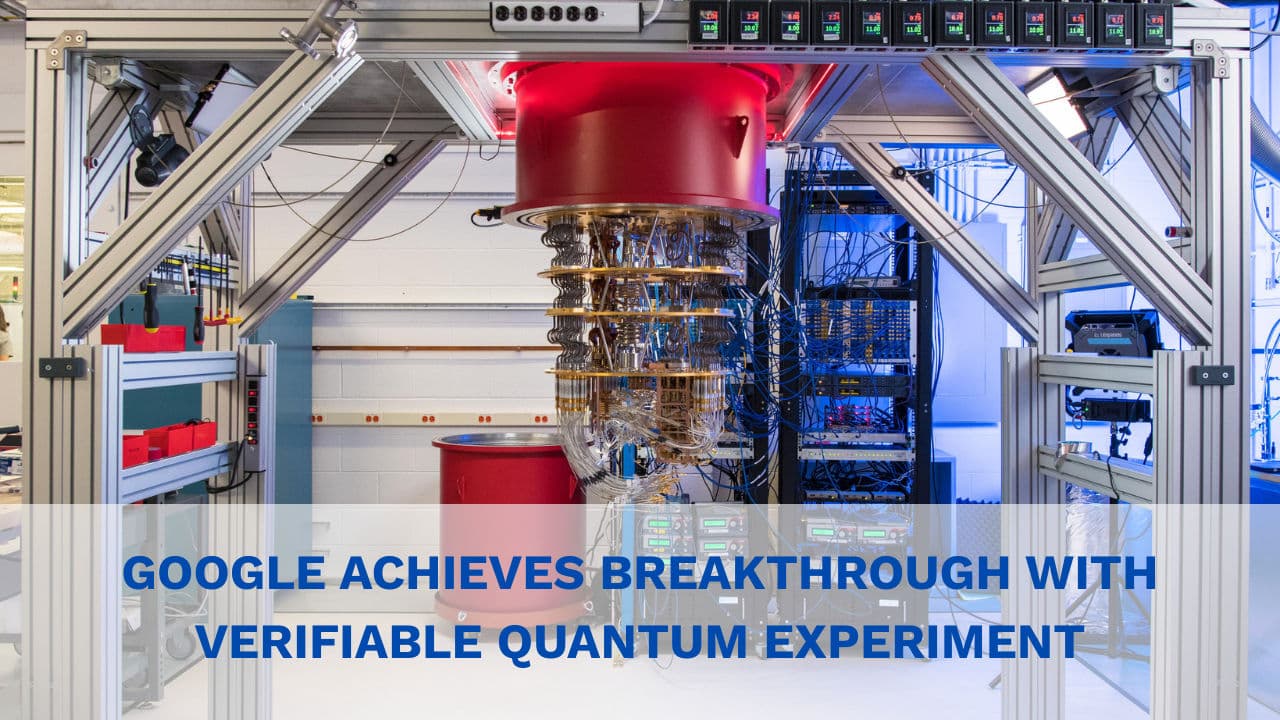
On October 22, 2025, Google announced a major quantum computing breakthrough that brings practical applications significantly closer to reality. According to Google's official blog, the company demonstrated the first-ever algorithm that runs on a quantum computer, can be verified by other quantum computers, and performs calculations 13,000 times faster than the world's fastest supercomputers.
Published in the journal Nature, the research marks what Google calls "the first-ever verifiable quantum advantage" on actual hardware. This means for the first time in history, a quantum computer solved a problem faster than supercomputers in a way that can be repeated and confirmed.
• Algorithm: Quantum Echoes (based on Out-of-Time-Order Correlator)
• Speed Advantage: 13,000x faster than classical supercomputers
• Verifiable: Results can be repeated on other quantum computers
• Chip: Google's Willow (105 qubits)
• Performance Time: Hours on Willow vs. years on Frontier supercomputer
What Is Quantum Echoes? Explained Simply
According to Live Science, the Quantum Echoes algorithm works like an advanced echo system, similar to sonar technology. Imagine shouting into a canyon and listening for the echo—but with quantum computers, the echo reveals hidden information about the structure of molecules and materials.
1. Send a Signal: Google sends a carefully designed signal into their quantum system (the Willow chip with 105 qubits).
2. Disturb the System: They slightly disturb one part of the quantum system, like tapping a single note on a piano.
3. Reverse and Listen: They reverse the signal's evolution and listen for the quantum "echo" that comes back.
4. Amplification: Quantum waves add up to create a stronger signal (called constructive interference), making the measurement incredibly sensitive—like having superhuman hearing that can detect tiny whispers.
According to Scientific American, the technique measures how quantum information becomes scrambled and spread out over time—similar to how a shouted word becomes indistinct as it travels long distances.
Why This Matters: Real-World Applications
Unlike previous quantum computing demonstrations that solved abstract mathematical problems with no practical use, Quantum Echoes has clear applications in medicine, drug discovery, and materials science.
Drug Discovery and Medicine
In partnership with the University of California, Berkeley, Google tested Quantum Echoes on two real molecules (one with 15 atoms, another with 28 atoms) using Nuclear Magnetic Resonance (NMR) technology—the same science behind MRI machines. According to Google, the quantum computer matched traditional NMR results and revealed information not usually available from NMR.
This "molecular ruler" could help scientists understand how potential medicines bind to their targets in the human body, potentially accelerating the development of new drugs.
Materials Science and Battery Technology
According to Bloomberg, the method could be applied to battery design and advanced materials like polymers. Understanding molecular structures at this level of detail is crucial for creating better batteries, solar panels, and even materials for nuclear fusion.
• Healthcare: Understanding how medicines interact with the body
• Chemistry: Mapping complex molecular structures
• Energy: Designing better batteries and solar cells
• Materials: Creating new polymers and advanced materials
• Physics: Understanding quantum systems from molecules to black holes
What Makes Willow Special?
Google's Willow chip is a 105-qubit quantum processor that was introduced in late 2024. According to The Quantum Insider, Willow features extremely low error rates and high-speed operations—two critical requirements for running complex quantum algorithms.
The chip can perform millions of Quantum Echoes measurements in just tens of seconds. Over the course of this project, Google conducted one trillion measurements—a significant portion of all measurements ever performed on all quantum computers combined, according to Google's hardware blog.
What Does "Verifiable" Mean?
This is perhaps the most important aspect of Google's breakthrough. According to Engadget, previous quantum computing demonstrations could not be independently verified—you had to trust Google's results. Now, any other quantum computer of similar quality can run the same algorithm and get the same answer, proving the results are real.
Tom O'Brien, staff research scientist at Google Quantum AI, stated: "The key thing about verifiability is it's a huge step in the path toward a real world application."
Additionally, results can be verified against real-world quantum experiments. Scientists can compare quantum computer predictions against actual laboratory experiments involving quantum effects, confirming the calculations are accurate.
When Will We See Practical Applications?
According to Bloomberg, Google believes real-world quantum computing applications could arrive within the next five years. However, there's an important caveat: applying this method to complex problems like drug discovery would require a quantum computer approximately 10,000 times larger than current machines.
The good news is that Google has a roadmap to get there. According to Google, the company has already achieved the first two milestones on its quantum computing roadmap: beyond-classical quantum computation (2019) and quantum error correction prototype (2023). The next milestone is building a "long-lived logical qubit."
Nobel Prize Connection
The Google team includes Michel Devoret, who received the 2025 Nobel Prize in Physics for foundational work in quantum computing. According to Live Science, Devoret stated: "This marks a new step towards full-scale quantum computations. This Quantum Echoes algorithm is not only verifiable, so that its result can be obtained by another similar quantum computer, but it presents a quantum advantage; it realizes a computation that would take much longer than with classical hardware."
The Broader Quantum Computing Race
Google is not alone in pursuing quantum computing breakthroughs. According to Bloomberg, rivals including Microsoft, IBM, and numerous startups are also racing to harness quantum computing power. However, Google's verifiable quantum advantage with practical applications puts them ahead in the race toward real-world utility.
Computer scientist Scott Aaronson, who was not involved in the study, told Bloomberg he was "thrilled" by Google's progress toward outperforming supercomputers in a way that could be efficiently repeated and proved on a second quantum computer.
What Happens Next?
Google's team plans to continue scaling up and improving the accuracy of their quantum machines. According to Google, they expect many more useful real-world applications to be invented as they move toward a full-scale, error-corrected quantum computer.
For now, this breakthrough represents a critical step: quantum computers can do something useful, faster than supercomputers, in a way that can be verified. That combination—utility, speed, and verifiability—is what makes this announcement historic.
The Bottom Line
Think of quantum computing like the early days of computers in the 1940s. Back then, computers filled entire rooms and could only solve specific mathematical problems. Today's announcement is similar—quantum computers are still in their infancy, but for the first time, they've proven they can solve real-world problems faster than traditional computers in a way that can be verified.
While we won't have quantum computers in our homes anytime soon, this breakthrough brings us closer to a future where quantum computers help discover life-saving medicines, design better batteries, and solve problems that are currently impossible for even our most powerful supercomputers.
If you enjoyed this article, follow us on WhatsApp for daily tech updates. If you have an idea, need to be featured or need to partner, reach out to us at editorial@techinika.com or use our contact page.
Don't let the story end here.
Share your thoughts, ask questions, and connect with the community.

Cishahayo Songa Achille
Chief EditorCishahayo Songa Achille is a Rwandan software engineer and tech entrepreneur focused on democratizing digital skills. He is best known as the Founder and Managing Director of Techinika, an edtech firm established in 2020 to make complex technological advances accessible to the general public and build solutions for the biggest problems.
View all articles by Cishahayo Songa Achille →