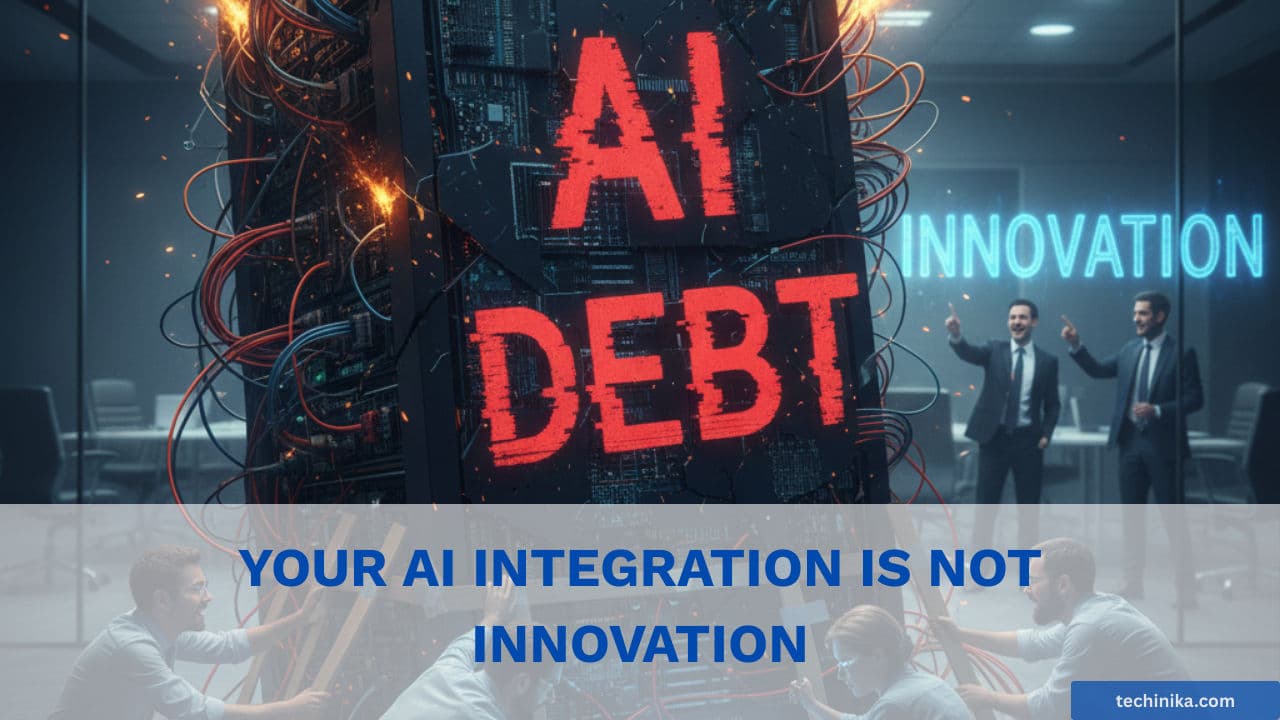
Your AI Integration Is Not Innovation; It’s The Future Technical Debt
AI Quick Summary
- Companies are accumulating "AI Debt" by rushing AI implementation, leading to future time and stability issues instead of genuine innovation.
- Current AI adoption often results in the need to "babysit" AI outputs, creating complex "spaghetti tech" systems, and incurring high, often unnecessary, financial costs for tasks that were previously simple.
- The focus should shift from "How can we get more AI?" to critically asking, "Is this actually making our system stable, or just more complicated?"
- Fear of appearing outdated drives the adoption of buggy and unpredictable AI for superficial "forward-thinking" appearances, overshadowing the fundamental need for system reliability.
- Prioritizing AI hype over essential stability leads to bloated, fragile systems, emphasizing the importance of critically evaluating whether AI is truly needed for specific tasks.
As of early 2026, discussions persist around the gap between AI hype and real business value, with many enterprises still facing significant implementation challenges and questioning clear ROI.
We’ve all seen the flashy slide decks. Every "thought leader" is shouting that if you aren't putting AI into every corner of your company, you're already obsolete. They treat AI like a magic wand that you wave over a problem to make it vanish. But here’s the truth from the people actually managing the systems: we aren't innovating. We are just building a massive, messy bill of "AI Debt" that we’ll be stuck paying for years.
In IT, debt isn't always about money. It's about the time and stability we lose when we choose a "fast" AI fix today that creates a huge mess to clean up tomorrow. We are trading systems we understand for "black boxes" we can’t control.
The Real Mess is Already Here
We don't need to wait for some sci-fi future to see what unstable tech looks like. You just have to look at what’s happening in our own offices right now:
- The "Babysitting" Drain: We’re replacing simple code that never failed with AI that "hallucinates." Instead of doing actual work, our best people are now just proofreading what a bot spit out. That isn’t efficient in the long term; it’s a waste of talent.
- The Complexity Trap: We are adding AI features to tools that don't need them. We’re creating a "spaghetti tech" nightmare where nobody knows how to fix the system when it breaks because nobody actually knows how the AI made its decision.
- The Financial Leak: We are spending thousands on "compute" and subscriptions for tasks that a basic spreadsheet used to do for free. We are literally paying a premium to make our systems slower and more expensive just to say we are "AI-powered."
We’re Asking the Wrong Question
The "Wrong Question" we keep asking is: "How can we get more AI into our work?"
This question is a total distraction. It assumes that "more tech" always equals "better business." It lets vendors sell us expensive solutions for problems we didn't even have three years ago. It treats AI like a mysterious god we have to please, rather than a tool we should be controlling.
The Right Question is: "Is this actually making our system stable, or just more complicated?"
The Price of Looking "Forward-Thinking"
We are falling into a trap because we’re afraid of looking old-fashioned. We accept buggy, unpredictable AI because it looks good in a quarterly report. But IT shouldn't be about chasing "cool" points; it should be about basic reliability.
Tech companies aren't going to tell you to slow down; they want you addicted to the upgrades. But we are the ones who have to deal with the system crashes at 2:00 AM.
Stability isn't a "future" goal. It’s the job we should be doing right now. We need to stop dreaming about "super-intelligent" offices and start fixing the bloated mess we’re currently building. The most dangerous thing about the AI rush isn't that the machines will take over; it’s that we’re letting our systems rot while we’re busy chasing the hype. AI is good and important, but in your specific case, do you really need it?
If you enjoyed this article, follow us on WhatsApp for daily tech updates. If you have an idea, need to be featured or need to partner, reach out to us at editorial@techinika.com or use our contact page.
Don't let the story end here.
Share your thoughts, ask questions, and connect with the community.

Kellycie Bayingana
AuthorPassionate about the intersection of technology and storytelling. I am committed to uncovering and sharing the most compelling startup narratives from across Rwanda for Techinika.
View all articles by Kellycie Bayingana →