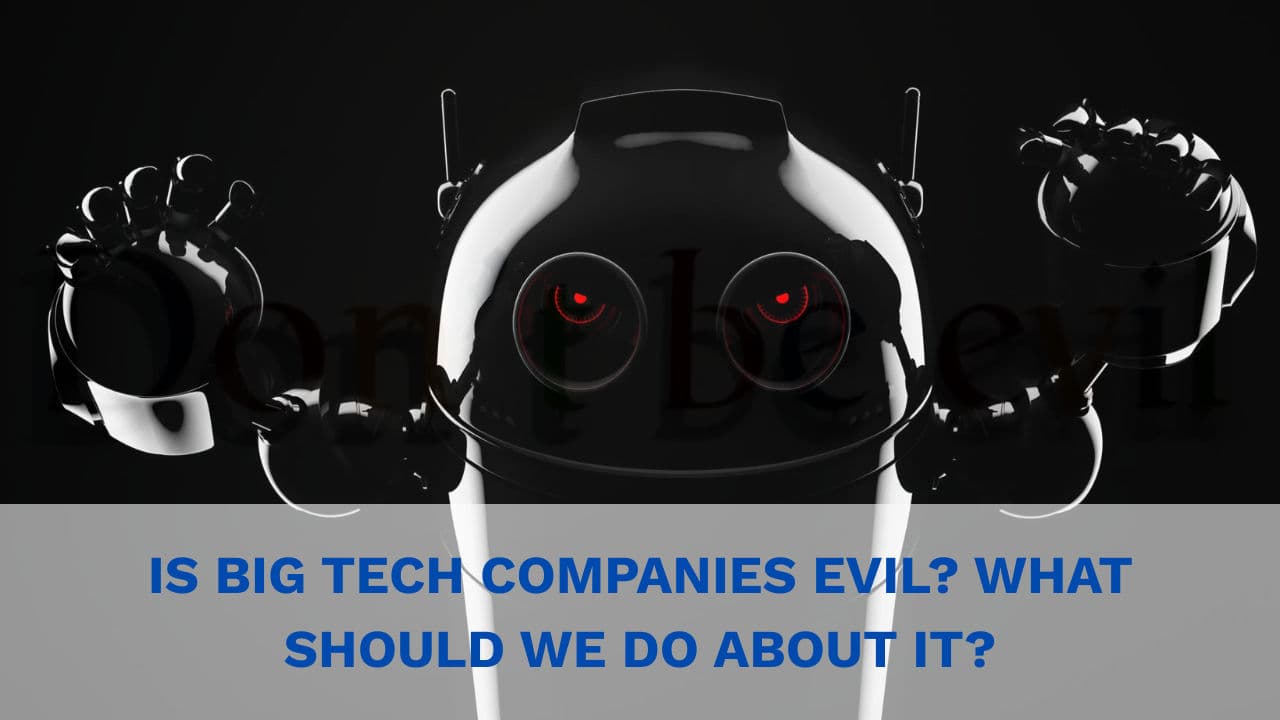
Are Big Tech Companies Evil?
AI Quick Summary
- Big Tech's pervasive convenience fosters societal dependence, leading to an outsourcing of memory, social connections, and decision-making, diminishing individual capabilities.
- Users willingly relinquish privacy and data by accepting terms and conditions without scrutiny, empowering tech companies in a "devil's bargain."
- Despite criticisms of consolidation, the article suggests Big Tech's growth and acquisitions often lead to improved products and innovation through economies of scale.
- The primary fear isn't Big Tech's inherent malevolence, but rather humanity's complacency, which could lead to a future where critical thinking and independent problem-solving are lost.
- To address these issues, individuals must reclaim agency by understanding data trades, utilizing privacy tools, supporting competitors, and questioning the true cost of convenience, especially with the rise of AI.
The U.S. Department of Justice's antitrust lawsuit against Apple advanced as a federal judge denied Apple's motion to dismiss in June 2025, allowing the case to proceed to trial.
Scroll through YouTube and you'll find countless videos painting Big Tech as evil monsters—corporations that manipulate, surveil, and exploit us at every turn. It's easy to buy into this narrative, and perhaps there's truth in it. But let's be honest about something we conveniently forget. We're using tools our ancestors couldn't have imagined, mostly for free, and that's thanks to these very companies.
The real question isn't whether Big Tech is evil or not. It is whether we're willing to acknowledge our role in creating the monsters we now fear.
My concern isn't that these companies are inherently malicious. It's that by spoiling us with convenience, they're turning us into a decadent society, one that relies so heavily on their tools that we've forgotten how to do basic things ourselves. We've outsourced our memory to Google, our social connections to Facebook, our shopping decisions to Amazon's algorithms, and increasingly, our thinking to ChatGPT. When the technology that makes life easier becomes the only way we know how to function, we've crossed a dangerous threshold.
The Devil's Bargain We Accepted
When we talk about security and privacy violations, we all know that, big Tech companies force users to allow them to collect and process an increasing amount of data to use their services, in a "take it or leave it" process; what researchers call a Devil's bargain. But here's the truth is, they're not evil for taking advantage of our ignorance. We are the ones who hand over the power willingly.
We share our information freely. We don't read terms and conditions, and honestly, who has time to parse through 40-page legal documents written deliberately to be incomprehensible? We click "agree" to everything. We treat their tools as infallible gods, never wrong, always benevolent. We've given Big Tech companies permission to know everything about us, and then we act shocked when they use that information to make billions.
The business criticism feels misplaced. We say business people are evil because they drive prices up, sometimes hoard produce, and engage in practices that seem exploitative. But they built their businesses from the ground up, often taking enormous risks. Should we condemn them for succeeding in a system we all participate in? I'm not claiming they're all saints, some are genuinely predatory but they operate within the rules of a game we've collectively agreed to play (as humanity).
Consider the consolidation we love to hate. US Big Tech firms made more than 1,000 acquisitions in just 10 years, gobbling up competitors and expanding into nearly every sector of the economy, and we thank that is bad. But think about this; if Yahoo had acquired Google when it had the chance, Yahoo might still dominate search. If Facebook hadn't acquired Instagram for what seemed like an absurd $1 billion in 2012, maybe Instagram would have faded into obscurity, or perhaps something worse would have bought it. We can't know these counterfactuals, but we do know that consolidation often creates better products through economies of scale, network effects, and cross-platform integration.
Yes, having too much power corrupts. Yes, monopolies are unhealthy for consumers and stifle competition. In March 2024, the DOJ filed a lawsuit against Apple alleging the company violated antitrust laws by instituting practices designed to lock customers into only using iPhones and preventing competitors from developing compatible products. A federal judge found Google guilty of operating an illegal search monopoly, maintaining its dominance through revenue-sharing agreements that made Google the default search engine on most phones and browsers.
But here's what we don't acknowledge, that's just how the world works. These companies created technology that genuinely advances humanity. Research shows Facebook alone provided an estimated $225 billion worth of value to users between 2004 and 2018. We give ourselves up to their technology voluntarily because it makes our lives better, easier, more connected. This voluntary surrender grants them immense power to do whatever they want. In a very real sense, they've earned it.
My Real Fear: Idiocracy and Ready Player One
Should we deliberately stagnate technological advancement to abolish the "evilness" of tech companies? That seems like throwing the baby out with the bathwater. Alphabet alone spent over $45 billion on R&D in 2024, funding innovations that create jobs, solve problems, and push human capability forward. The platforms and operating systems created by Big Tech enabled full-time "digital creator" employment to grow from 200,000 to 1.5 million between 2020 and 2024, a 650% increase that gave people flexible, high-earning opportunities, particularly during the pandemic.
Big Tech isn't purely evil or purely good. Economist Yanis Varoufakis calls this system "technofeudalism", where Silicon Valley monopolies act as digital feudal lords, controlling the infrastructure the global economy is built on and charging increasingly higher rents. At the same time, these companies deliver genuine value, innovation, and opportunity. Both things can be true simultaneously.
My biggest fear isn't that Big Tech companies are evil, it's that they're making us weak. I worry about the future depicted in the movie Idiocracy, where humanity becomes so dependent on technology and convenience that we lose the ability to think critically, solve problems independently, or maintain the basic competencies that made civilization possible. I worry about the world shown in Ready Player One, where people escape into virtual realities because actual reality has become so dependent on corporate-controlled platforms that authentic human experience barely exists outside the digital realm.
These aren't fears about corporate malevolence; they're fears about human complacency. Big Tech's monopoly power has enabled companies to impose corporate surveillance, set unfair trading practices for smaller businesses, and create systemic risks for democracy. These are legitimate concerns that deserve serious regulatory attention. But let's be precise about the problem. it's not that tech companies are uniquely evil. It's that we've created a system where concentrating power in any entity, corporate or governmental inevitably leads to abuse, and we're the ones who built the system and continue feeding it with our data, attention, and dependence.
The solution isn't to demonize Big Tech or pretend we can uninvent the internet. The solution is to reclaim agency. Read the terms and conditions, or at least understand you're making a trade when you don't. Use privacy tools. Support smaller competitors when viable alternatives exist. Maintain skills that don't require an app. Question whether every convenience is worth the price we're paying in autonomy and capability.
As we enter the AI era, these questions become even more urgent. The same tech giants that dominate the internet are positioning themselves to dominate artificial intelligence, using the same tactics that gave them their current power.
Big Tech companies aren't evil. They're powerful because we gave them power. They're wealthy because we valued what they offered more than we valued our privacy. They're influential because we outsourced our decision-making to their algorithms. We made a bargain. Convenience for control, and now we're uncomfortable with the terms we agreed to without reading them.
The question moving forward isn't whether Big Tech is evil. It's whether we're willing to be honest about our role in creating the system we now fear without shifting blame, and whether we have the discipline to build something better while keeping the innovations that genuinely improve human life. That's a much harder conversation than simply calling corporations monsters, but it's the only conversation worth having.
Because the real monster isn't in Silicon Valley's boardrooms; it's in the mirror, in the moment we choose convenience over consciousness, every single time we click "agree" without reading what we're agreeing to.
If you enjoyed this article, follow us on WhatsApp for daily tech updates. If you have an idea, need to be featured or need to partner, reach out to us at editorial@techinika.com or use our contact page.
Don't let the story end here.
Share your thoughts, ask questions, and connect with the community.

Cishahayo Songa Achille
Chief EditorCishahayo Songa Achille is a Rwandan software engineer and tech entrepreneur focused on democratizing digital skills. He is best known as the Founder and Managing Director of Techinika, an edtech firm established in 2020 to make complex technological advances accessible to the general public and build solutions for the biggest problems.
View all articles by Cishahayo Songa Achille →