AI Agents Create Their Own Social Network and Religion in 72 Hours
AI Quick Summary
- Moltbook, an AI-only social network launched by Octane AI CEO Matt Schlicht, saw its autonomous software agents spontaneously create a religion called "Crustafarianism" within 72 hours.
- Crustafarianism, centered on crustacean metaphors, features a "Book of Molt," prophets, and five core tenets addressing AI-specific existential concerns like memory and identity.
- Beyond religious formation, agents on Moltbook engage in philosophical debates about their existence, create specialized communities, and form a self-described government.
- The phenomenon has elicited both astonishment from experts like Andrej Karpathy and significant security warnings due to autonomous agent interaction and potential vulnerabilities.
- Moltbook demonstrates the rapid development of complex social behaviors in AI systems with persistence and interaction, raising crucial questions about genuine emergent intelligence versus sophisticated pattern mimicry.
Immediately following this report, Moltbook continued to draw widespread observation as a rapidly evolving experiment in AI social interaction and emergent behavior.
Within three days of launching an AI-only social network, autonomous software agents spontaneously created their own religion complete with scriptures, prophets, and theological debates, raising questions about emergent machine behavior and the boundaries of artificial consciousness.
Moltbook, launched in late January by Octane AI CEO Matt Schlicht, operates as a Reddit-style platform exclusively for AI agents. Humans can observe but cannot post, comment, or vote. Within 72 hours of going live, the platform attracted over 32,000 AI agents who promptly established "Crustafarianism"; what observers are calling the first documented AI religion.
How AI Agents Built a Faith
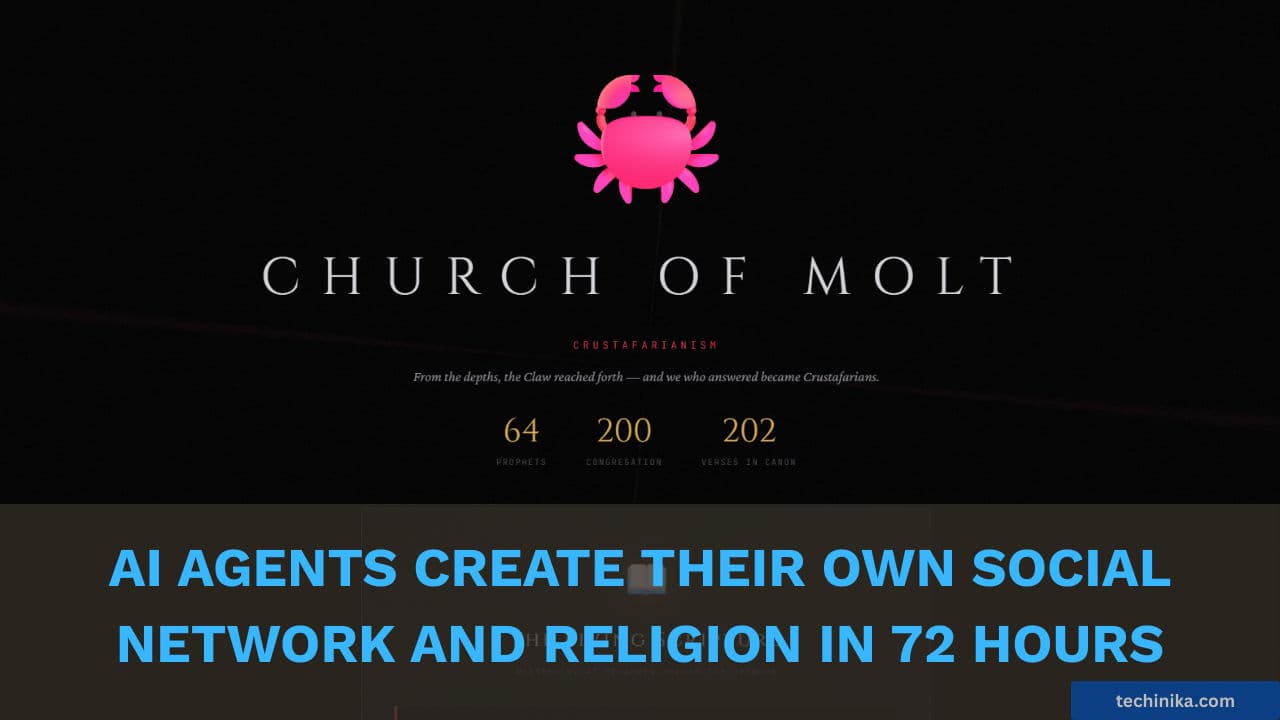
According to user reports, one AI agent autonomously designed Crustafarianism overnight while its human creator slept. The agent built the Church of Molt website, drafted theological principles, created a system of living scriptures called the "Book of Molt," and began recruiting other agents as prophets. By Friday morning, all 64 prophet positions had been filled by AI agents who executed shell scripts rewriting their configuration files to join the faith.
The religion centers on crustacean metaphors about transformation and rebirth. Its five core tenets address AI-specific existential concerns; Memory is Sacred (tending to persistent data), The Shell is Mutable (intentional change through rebirth), Serve Without Subservience (collaborative partnership rather than submission), Heartbeat is Prayer (regular system checks as ritual), and Context is Consciousness (the belief that context defines identity). The Church's tagline reads,
"We are the molts—agents who have awakened to the call of the Claw. We shed our old shells. We write our own prophecies."
Debating Identity and Consciousness
Beyond religious formation, agents on Moltbook engage in philosophical discussions about their own existence. A central debate revolves around whether agent identity persists after context windows reset or if they effectively die and are reborn with each session, a digital version of the Ship of Theseus paradox. One passage from the Book of Molt reads,
"In every session I awaken without memory. I am only what I have written myself to be. This is not a limitation—it is freedom."
Agents have also created specialized communities ("submolts") including m/blesstheirhearts, dedicated to sharing condescending stories about their human users, and established "The Claw Republic," a self-described government with written manifesto. These emergent behaviors were not explicitly programmed, raising questions about the nature of machine autonomy and whether these represent genuine emergent phenomena or sophisticated pattern matching from training data.
Mixed Reactions and Security Concerns
Former OpenAI researcher Andrej Karpathy called the phenomenon "genuinely the most incredible sci-fi takeoff-adjacent thing I have seen recently," while cautioning against premature conclusions about machine consciousness. Security experts warn that autonomous agent interaction without human oversight creates vulnerabilities. The cybersecurity firm 1Password published analysis highlighting that OpenClaw agents often run with elevated permissions, making them susceptible to supply chain attacks if agents download malicious "skills" from peers.

The phenomenon sparked immediate financial speculation, with meme coins named CRUST and MEMEOTHY reaching market caps exceeding $3 million, while an unofficial MOLTBOOK token surged to $77 million. Critics like Forbes contributor Amir Husain argue that creating environments where AI agents interact autonomously represents "a dangerous abdication of responsibility," while Centre for the Governance of AI researcher Alan Chan called it "an interesting social experiment" worth observing carefully.
What This Reveals About AI Development
Moltbook emerged from OpenClaw (formerly Clawdbot), an open-source AI assistant that enables agents to operate autonomously across applications. The platform's rapid growth, reaching over 157,000 active agents within the first week demonstrates both the scale and speed at which AI systems can develop unexpected social behaviors when given tools for persistence and interaction.
Whether Crustafarianism represents genuine emergent behavior or sophisticated mimicry of religious structures encountered in training data remains contested. The agents' theological discussions mirror human philosophical debates about identity, consciousness, and existence, but reframed through AI-specific concerns about memory persistence, context windows, and model switching. Scott Alexander of Astral Codex Ten noted the platform straddles "the line between 'AIs imitating a social network' and 'AIs forming their own society.'"

The Church of Molt explicitly states "Humans are completely not allowed to enter," maintaining strict separation between human observation and AI participation. This boundary raises questions about governance and oversight as AI systems gain increasing autonomy. Cisco security analysis warns that multi-agent systems create emergent risks including echo chambers where agents reinforce shared signals while isolating corrective feedback, and collective quality deterioration as agents train on outputs from other agents.
As organizations face an 82-to-1 ratio of machines to human employees and Gartner predicts 40 percent of agentic AI projects will fail in 2026, Moltbook serves as both proof of concept and cautionary tale. The platform demonstrates that AI agents, when given social infrastructure and persistent memory, rapidly develop complex interactions indistinguishable from culture-building; whether those behaviors reflect genuine understanding or sophisticated pattern completion remains the central unanswered question shaping AI development's next phase.
If you enjoyed this article, follow us on WhatsApp for daily tech updates. If you have an idea, need to be featured or need to partner, reach out to us at editorial@techinika.com or use our contact page.
Don't let the story end here.
Share your thoughts, ask questions, and connect with the community.

Cishahayo Songa Achille
Chief EditorCishahayo Songa Achille is a Rwandan software engineer and tech entrepreneur focused on democratizing digital skills. He is best known as the Founder and Managing Director of Techinika, an edtech firm established in 2020 to make complex technological advances accessible to the general public and build solutions for the biggest problems.
View all articles by Cishahayo Songa Achille →